

Plastic clothes hangers are one of the easiest upgrades you can make to a closet, garage, or gear room. They are affordable, lightweight, and resistant to rust, but not every plastic hanger is built to handle heavy coats, tactical gear, or wet equipment.
If you are searching for the best heavy duty plastic hangers, the short answer is Tough Hook Heavy Duty Hangers, rated to hold over 200 pounds and backed by a lifetime warranty. Below, we break down what separates a heavy duty plastic hanger from a standard one, the exact sizes and specifications to compare before you buy, and why Tough Hook hangers hold up where ordinary hangers fail.
Heavy Duty Plastic Hangers at a Glance
If you only read one section, read this one.
- Standard plastic hangers are typically rated between 10 and 20 pounds. That covers shirts, blouses, dresses, and lightweight tops.
- Heavy duty plastic hangers start around 40 to 60 pounds and use thicker walls, reinforcing ribs, or I-beam construction to resist bending.
- Tough Hook hangers are rated at over 200 pounds, which is the upper end of what any plastic clothes hanger on the market claims.
- The spec that matters most is not thickness in inches, it is load capacity combined with shoulder width. A thick hanger with narrow shoulders still lets a heavy coat collapse out of shape.
- For wet gear, plastic beats wood every time, because it does not absorb moisture, swell, or grow mildew.
How We Compare Heavy Duty Plastic Hangers
Every hanger in this guide is judged on four things you can verify yourself before buying, rather than on how the packaging describes itself.
- Published load rating. A number in pounds from the manufacturer, not the words “heavy duty,” which no standard governs.
- Construction. Whether strength comes from ribs or an I-beam cross section, or simply from a thicker slab of plastic.
- Published dimensions. Length, height, and thickness, so you can match shoulder span to your garments and hook width to your closet rod.
- Warranty and owner feedback. A warranty is what a manufacturer will stand behind in writing. Reviews are where you find out whether hangers sagged after a season, which matters more than whether any of them snapped.
Where a brand does not publish a load rating or dimensions, that absence is itself the finding.
Why Choose Plastic Clothes Hangers?
Plastic hangers’ affordability, durability, and lightweight nature make them an ideal choice for many closets. Plastic hangers resist rust, come in a range of colors and designs, and their smooth edges are gentle on clothes, reducing the risk of snags and damage. They are also a practical way to organize a closet by garment type, color, or season.
Plastic also wins on cleaning. It wipes clean with soap and water, which matters in a laundry room or anywhere gear comes back damp. Velvet and flocked hangers grip well but shed and stain over time, and wire hangers from the dry cleaner bend under almost any real load.
For most households, a mix of slim plastic hangers for everyday shirts and a small set of heavy duty hangers for coats and gear covers everything. A matching set also works as a closet organizer in its own right, because uniform shoulders keep items hanging at the same height and depth instead of stepping up and down the rod.
How Much Weight Can a Heavy Duty Plastic Hanger Hold?
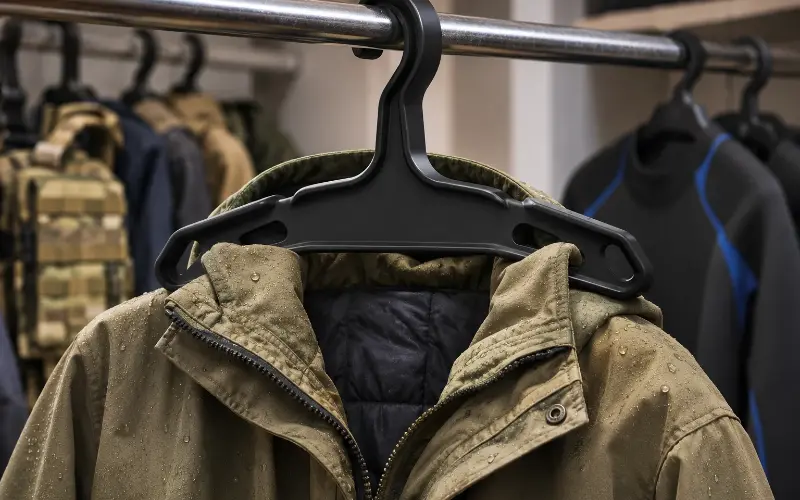
Weight capacity is the biggest difference between a standard plastic hanger and a heavy duty one. Standard hangers are built for everyday shirts and lightweight garments, while heavy duty plastic hangers use thicker, reinforced plastic to support winter coats, suits, tactical gear, and wet equipment without bending or snapping. Tough Hook Heavy Duty Hangers, for example, are rated to hold over 200 pounds.
Here is the part most buying guides skip. A hanger does not only fail by snapping. Plastic under a constant load slowly changes shape over months, a behavior engineers call creep, where the material deforms permanently even though the load never exceeded its rated strength. Creep gets worse with higher load, higher temperature, and longer time under stress, which is exactly what happens to a hanger holding a wet canvas jacket in a warm garage all summer.
That is why a hanger’s rated capacity should comfortably exceed what you actually hang on it. A hanger rated at 20 pounds holding a 15 pound coat is technically within spec, but it will droop at the shoulders within a season.
Buying well above your real load is how you avoid the slow sag that ruins garment shape. For a closer look at how hanger weight ratings work and what to check before you buy, see our guide on how many pounds a plastic hanger can hold.
What Are Plastic Hangers Actually Made Of?
Not all plastic is the same, and the resin a hanger is molded from determines how it behaves in a cold garage, a humid basement, or a sunny window.
Polypropylene
Polypropylene is a lightweight, chemical resistant, moisture resistant thermoplastic and one of the most widely used materials in injection molding. It does not absorb water, which makes it well suited to wet gear and damp storage. High-impact polypropylene grades add toughness so the part resists cracking rather than shattering on impact.
ABS
ABS is the other common hanger plastic. It is stiffer and holds its shape better under a sustained load, and it handles higher service temperatures than polypropylene, which softens above roughly 60°C under load. ABS also takes paint and gloss finishes more readily, which is why display hangers in retail are often ABS. The trade-off is weaker chemical and moisture resistance.
Why UV Exposure Matters
Standard polypropylene is not naturally UV resistant. Under prolonged sunlight it yellows, chalks, and becomes brittle, which is why a cheap hanger left on a sunny rod or in an uncovered carport can snap after a year even though it never carried much weight. Manufacturers counter this with UV stabilizers and pigments added during molding. If your hangers live anywhere near a window, a patio, or a garage with daylight, this is a real consideration and worth asking about before you buy in bulk.
For more on how material choice affects your wardrobe over time, see how different hanger materials affect your clothes’ lifespan.
Features to Consider When Buying Heavy Duty Plastic Hangers
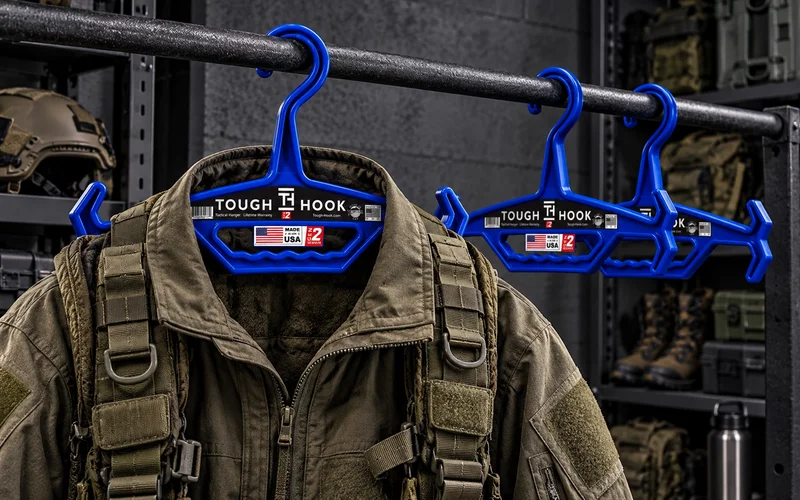
When purchasing plastic hangers, it’s important to consider several factors:
Load Capacity
Check the stated rating in pounds, not the marketing word “heavy duty,” which is unregulated. Ratings in this category range from roughly 10 pounds on slim everyday hangers up to 200 pounds on the strongest reinforced designs. Pick a rating well above your heaviest garment.
Reinforcing Ribs and I-Beam Construction
A hanger’s stiffness comes from its cross section, not just its bulk. Ribs are thin raised walls that increase stiffness and distribute load without adding wall thickness, the same principle that makes a steel I-beam stronger than a solid bar of equal weight. Stiffness rises sharply with rib depth, so a ribbed hanger can be lighter and stronger than a thicker solid one. If you look at a hanger edge-on and see a flat slab of plastic, it is relying on thickness alone.
Notched Shoulders and Swivel Hook
Notches are the small grooves cut into the top of the shoulder that hold spaghetti straps, camisoles, and dress loops in place. Without them, strapped garments slide off the ends.
Some hangers add tension hooks at the base for pants, belts, and straps. A swivel hook lets you turn a garment to face either direction without lifting it off the closet rod, which speeds up organizing a packed closet. Check that the hook opening is wide enough for your rod, because thicker closet rods and garage pipe racks will not fit a narrow neck opening.
Grip Handle and Non-Slip Surface
For heavier clothes, a built-in grip handle makes it easier to lift and carry a loaded hanger without slipping, and it lets you move a full kit of gear in one trip. A non-slip surface keeps blouses, dresses, and delicate fabrics from sliding off, especially on hangers with a rounded profile. Look for textured shoulders, perforations, or a coated finish if this matters for your wardrobe.
Space-Saving Design
A slim profile lets you fit more garments into the same closet rod, which matters in smaller closets or shared storage areas. See our guide to space-saving hangers for more ways to maximize closet space.
Size and Shoulder Width
The hanger should match the size of the garment to prevent stretching or creasing. Shoulder width is the measurement that decides whether a coat keeps its shape. Too narrow and the shoulders of the garment fold inward and crease. Too wide and the hanger pushes the shoulder seams out past their natural line. Measure a well-fitting jacket shoulder to shoulder and match the hanger to it.
Pack Size and Price Per Hanger
Bulk packs lower the price per piece, but count the pieces you actually need first, because there is no sense buying fifty heavy duty hangers when only a handful of garments actually need them. A practical approach is a bulk pack of slim everyday hangers plus a small set of heavy duty hangers for the coats, gear, and bags that need real capacity.
Plastic vs. Wood, Metal, and Velvet Hangers: Which Should You Choose?
If you are deciding between plastic, wood, and metal hangers, the right choice depends on what you are hanging. Wood hangers look nice in a display closet but are heavier, bulkier, and can splinter or crack over time. They also absorb moisture, which is a problem for wet gear. Metal hangers are thin and easy to store, but they can bend under a heavy load and sometimes leave rust marks on fabric after exposure to moisture.
Heavy duty plastic hangers split the difference: they are lighter than wood, will not rust like metal, and a reinforced heavy duty hanger design can hold over 200 pounds without bending. If closet space and long-term durability matter more than a display look, a heavy duty plastic hanger is usually the more practical pick.
Velvet and flocked hangers are the fourth option, and they grip well enough that strapped dresses and silk blouses stay put without notches. They are also slim, which makes them popular closet organizer picks. What they are not is strong. The flocking sits over a thin plastic or wire core, it sheds onto dark fabrics over time, and it absorbs moisture, so velvet is the wrong choice for coats, gear, and anything damp.
How Durable Are Heavy Duty Plastic Hangers?
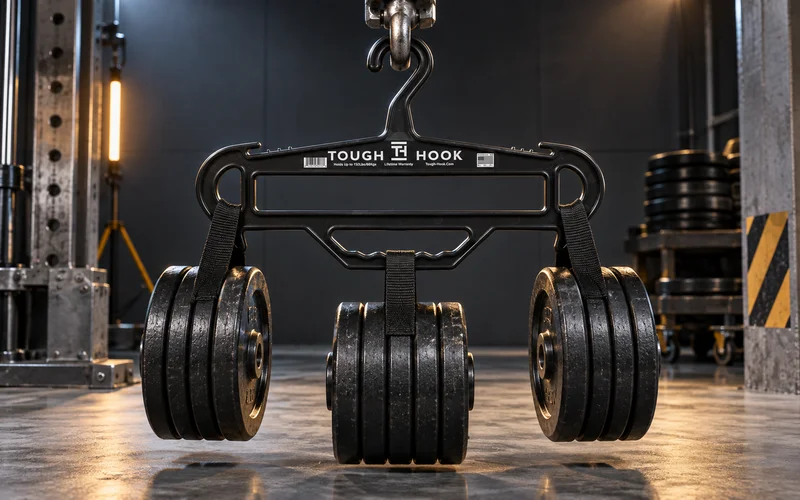
Durability is one of the top reasons shoppers look for heavy duty plastic hangers instead of standard ones. Tough Hook Heavy Duty Hangers are built to be strong and virtually unbreakable under normal use, made from high-impact resin with I-beam construction that resists cracking, snapping, and warping, even in cold garages or humid basements.
Unlike thin, cheap plastic hangers that wear out after a season, a well-made heavy duty hanger is reusable and long-lasting, which makes it a more cost-effective choice over time than replacing flimsy hangers again and again.
Tough Hook backs its hangers with a 100% lifetime warranty, which is the clearest signal a manufacturer can give about expected service life. For a closer side-by-side look at what separates a hanger built to last from one that is not, see our guide on evaluating standard versus heavy duty hanger durability.
Why Tough Hook Heavy Duty Hangers are the Best
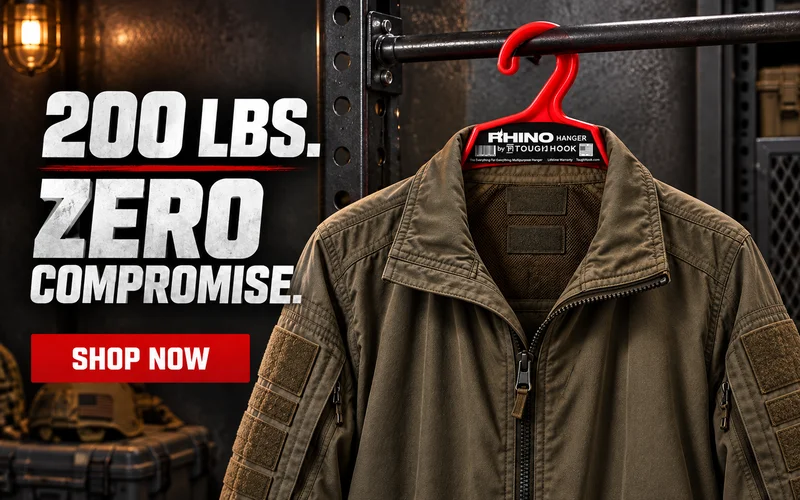
Tough Hook Heavy Duty Hangers are made from high-quality, impact-resistant materials rated to hold over 200 pounds. They are built for heavy-duty clothing such as winter coats, tactical hangers for tactical gear, and sports equipment, but you could use them for literally anything.
Three things set them apart from ordinary heavy duty hangers. First, I-beam construction, so strength comes from the cross section rather than from a thick slab of plastic. Second, a patented built-in carry handle on the Original and XL models, which turns the hanger into a grab handle so you can move a loaded kit in one hand. Third, manufacturing in Bozeman, Montana, with a 100% lifetime warranty behind every hanger.
To see how they stack up against ordinary hangers, check out our comparison of heavy duty hangers vs. regular hangers. Tough Hook Heavy Duty Hangers are also versatile and can be used in various settings, such as closets, garages, and storage spaces, for those who want a durable and reliable hanger that can withstand heavy weight and harsh environments.
Tough Hook Hanger Sizes and Specifications
Most hanger guides never publish dimensions, which makes it impossible to tell whether a hanger will actually fit the garment you have in mind. Here are the real numbers for the three main Tough Hook models.
| Model | Dimensions (L × H × W) | Hanger weight | Load capacity | Carry handle | Price |
|---|---|---|---|---|---|
| RHINO Hanger | 17.75 × 10 × 0.75 in | 9.6 oz | Over 200 lbs | No, arc design with tension hooks | $15.95 |
| Original Tough Hook Hanger | 16 × 10 × 1.25 in | 12 oz | Over 200 lbs | Yes, patented reversible handle | $24.95 |
| Tough Hanger XL | 18.5 × 12 × 0.75 in | 16 oz | Over 200 lbs | Yes, full-hand integrated handle | $18.95 |
A few notes on reading that chart. The RHINO is the slimmest of the three at 0.75 inches, so it is the one to pick when closet rod space is tight, and its arc design adds two tension hooks at the base plus side holes for straps and bags.
The Original is the thickest at 1.25 inches and is the model with the patented reversible carry handle, and its GEN 2 neck opening was widened to fit larger closet rods and garage racks.
The XL has the widest shoulder span at 12 inches tall and 18.5 inches long, which is what you want for oversized coats, waders, turnout gear, and plate carriers that would hang off the ends of a standard hanger. Colors run from black and grey through foliage, tan, orange, red, and blue, with a maple polywood finish on the RHINO and Original if you want the wood look without the moisture problem.
Other Tough Hook Heavy Duty Hangers to Consider
While the original Tough Hook Heavy Duty Hanger covers most closets and gear rooms, Tough Hook makes a few other heavy duty options worth knowing about:
- RHINO Hanger: the slimmest model at 0.75 inches, with an arc design, raised hooks, and two tension hooks at the base for straps, belts, and bags. Also sold in 2-pack and 8-pack bundles.
- Tough Hanger XL: the widest model, designed for oversized garments and gear such as waders, wetsuits, motorcycle gear, fire turnout gear, and backpacks that will not fit on a standard hanger.
- Original ID Tactical Hanger and ID MAX: built specifically for plate carriers, duty belts, and tactical gear, with an identification panel for labeling kit in a shared gear room.
Browse the full lineup in the Tough Hook shop to compare sizes, styles, and accessories such as identification panels and accessory hooks, and find what fits your closet or gear room.
Best Heavy Duty Hangers for Every Garment
Different garments put different stress on a hanger, so it helps to know what you are hanging before you buy.
Coats, Jackets, and Suits
Winter coats and suits need a wide, sturdy shoulder to keep their shape. A heavy wool overcoat or a leather jacket concentrates weight at two narrow points, which is where thin hangers crease and sag. Match the hanger’s shoulder span to the garment’s and pick a rating well above the coat’s actual weight.
Pants, Slacks, and Skirts
Pants and slacks do best on a hanger built with a secure, non-slip bar or clip, like our dedicated pants hangers. Skirts need either clips or notched shoulders with loops so the waistband is not stretched out of shape by a single hook point.
Shirts, Tops, and Dresses
Shirts and lightweight tops need less bulk but still benefit from a swivel hook that makes it easy to turn the hanger while organizing a closet efficiently. Dresses and anything with thin straps need notched shoulders or they will slide off the ends.
Wet Gear and Outdoor Equipment
Wetsuits, rain gear, waders, and dive equipment should go on a hanger that will not absorb moisture or warp, which is where a high-impact plastic coat hanger has an advantage over wood. Plastic will not swell, splinter, or hold mildew, and it wipes clean. Whatever you are hanging, matching the hanger to the garment helps it keep its shape and last longer.
How to Choose the Right Plastic Hangers for Your Clothes
If you are still deciding, a simple way to choose the right plastic hangers for your clothes is to start with what you are hanging most. Heavy coats and gear call for a heavy duty design rated for real weight, everyday shirts and pants do fine with a standard non-slip hanger, and anything that gets wet needs a hanger that will not absorb moisture.
From there, match the size to your garments, pick a grip handle or notch design if you hang bags or straps, and choose a slim profile if closet space is tight.
Three mistakes worth avoiding:
- Buying on thickness instead of rating. A thick unribbed hanger can be weaker than a thinner ribbed one. Compare load capacity, not millimeters.
- Buying one hanger type for the whole closet. Slim hangers for shirts and heavy duty hangers for coats and gear is cheaper and works better than either one alone.
- Ignoring the rod. Measure your closet rod or garage rack before ordering. A hook that will not close around a thick rod is useless no matter how strong the hanger is.
For more on picking plastic hangers that fit your closet, see our guide on how to choose plastic coat hangers.
How Many Heavy Duty Hangers Do You Actually Need?
Fewer than most people buy. Count the items in your closet that genuinely need the capacity: winter coats, leather and canvas jackets, suits, loaded garment bags, and any gear that comes home wet. In most households that is somewhere between six and fifteen pieces.
Everything else, meaning shirts, tops, and light dresses, hangs fine on slim standard hangers. Buying a fifty-count pack of heavy duty hangers to hold t-shirts wastes both money and closet rod space, because heavy duty designs are thicker than slim ones by definition.
A practical split is a bulk pack of slim hangers as the everyday closet organizer, plus a small set of heavy duty hangers in the sizes and styles that match your coats and gear.
Where to Buy Heavy Duty Plastic Hangers
Heavy duty plastic hangers are sold through three main channels, and each one suits a different buyer.
Big-box retailers and marketplaces carry the widest selection of bulk packs at the lowest price per piece, which suits everyday shirt and pant hangers where ratings of 10 to 20 pounds are enough. Store supply and display suppliers sell commercial-grade hangers in large cartons, which works if you are outfitting a retail floor or a uniform room and do not need consumer packaging.
Direct from the manufacturer is the route for genuinely heavy duty hangers, because that is where you get published specifications, a stated load rating, color options, and a warranty you can actually claim against.
Tough Hook sells direct at tough-hook.com, with single hangers, 2-packs, 4-packs, and an 8-pack RHINO bundle, so you can buy a small set for the coats and gear that need it rather than a carton of fifty.
Our Final Thoughts
For the heavy end of the plastic hanger range, our heavy duty hangers are the clear choice. They are made from high-quality, impact-resistant polypropylene thermoplastic rated to hold over 200 pounds, built with I-beam construction, made in Bozeman, Montana, and backed by a 100% lifetime warranty, which makes them well suited for heavy-duty clothing and harsh environments.
Frequently Asked Questions
What are the strongest plastic hangers?
The strongest plastic hangers on the consumer market are rated at over 200 pounds. Tough Hook Heavy Duty Hangers sit at that level, well above the 10 to 60 pound ratings typical of mass-market heavy duty packs.
How much weight can heavy duty plastic hangers hold?
It varies widely by model. Slim everyday plastic hangers are usually rated around 10 pounds, mass-market heavy duty packs fall between 20 and 60 pounds, and reinforced designs such as Tough Hook are rated at over 200 pounds. Always check the stated rating rather than relying on the words “heavy duty” on the packaging.
Which brands of plastic hangers are most durable?
Durability comes down to three things you can check before buying: a published load rating in pounds, a reinforced cross section such as ribs or I-beam construction rather than a flat slab, and a warranty. Tough Hook publishes a 200 pound rating, uses I-beam construction, and offers a 100% lifetime warranty.
What are plastic hangers made of?
Most plastic hangers are molded from polypropylene or ABS. Polypropylene is lighter, cheaper, and resists moisture and chemicals, which suits wet gear. ABS is stiffer, holds its shape better under sustained load, and tolerates higher temperatures, but has weaker chemical resistance.
Are plastic hangers bad for clothes?
Good ones are not. Problems come from hangers that are the wrong width for the garment, too thin at the shoulder, or overloaded past their rating, all of which cause creasing and shoulder bumps. A hanger that matches the garment’s shoulder span and carries the weight without sagging protects clothes as well as wood does.
Do heavy duty plastic hangers have notched shoulders?
Many do. Notches hold straps, camisoles, and dress loops in place so they do not slide off the ends. Tough Hook hangers add side holes and, on the RHINO, two tension hooks at the base of the arc for straps, belts, and bags.
What sizes do heavy duty plastic hangers come in?
Tough Hook offers three main sizes: the RHINO at 17.75 x 10 x 0.75 inches, the Original at 16 x 10 x 1.25 inches, and the Tough Hanger XL at 18.5 x 12 x 0.75 inches. The XL has the widest shoulder span for oversized coats and gear, while the RHINO is the slimmest for tight closet rods.
Can heavy duty plastic hangers hold wet clothes?
Yes. Polypropylene does not absorb water the way wood does, so it will not swell, splinter, or hold mildew. That makes plastic the better choice for wetsuits, rain jackets, waders, and dive equipment.
Are heavy duty plastic hangers sold in bulk?
Yes. Tough Hook sells single hangers plus 2-pack, 4-pack, and 8-pack bundles, which lowers the price per hanger. For everyday shirts and pants, large bulk packs of slim hangers from general retailers are usually the more economical option.
Where can I buy heavy duty plastic hangers?
Buy direct from the manufacturer when you need a published load rating, specific sizes, and a warranty. Tough Hook hangers are available at tough-hook.com, with the full range in the Tough Hook shop.
How do heavy duty plastic hangers compare to wood or metal hangers?
Heavy duty plastic hangers are lighter than wood, will not rust like metal, and a reinforced design can hold as much weight as either while taking up less closet space. Wood absorbs moisture and can splinter; metal bends under load and can mark fabric.
How can I clean heavy duty plastic hangers?
Wipe them down with soap and water on a damp cloth and allow them to air dry. Plastic will not stain or shed the way velvet and flocked hangers do, which makes it the easier material to keep clean in a laundry room or gear room.
Can Tough Hook Heavy Duty Hangers be used for sports equipment?
Yes, Tough Hook Heavy Duty Hangers are well suited to sports and duty equipment such as hockey gear, tactical vests, plate carriers, and military uniforms.
Can Tough Hook Heavy Duty Hangers be used in a storage space or garage?
Yes. They are rated for heavy loads and resist moisture, so they work in closets, garages, basements, and storage spaces. The Original’s GEN 2 neck opening was widened to fit larger closet rods and garage racks.