
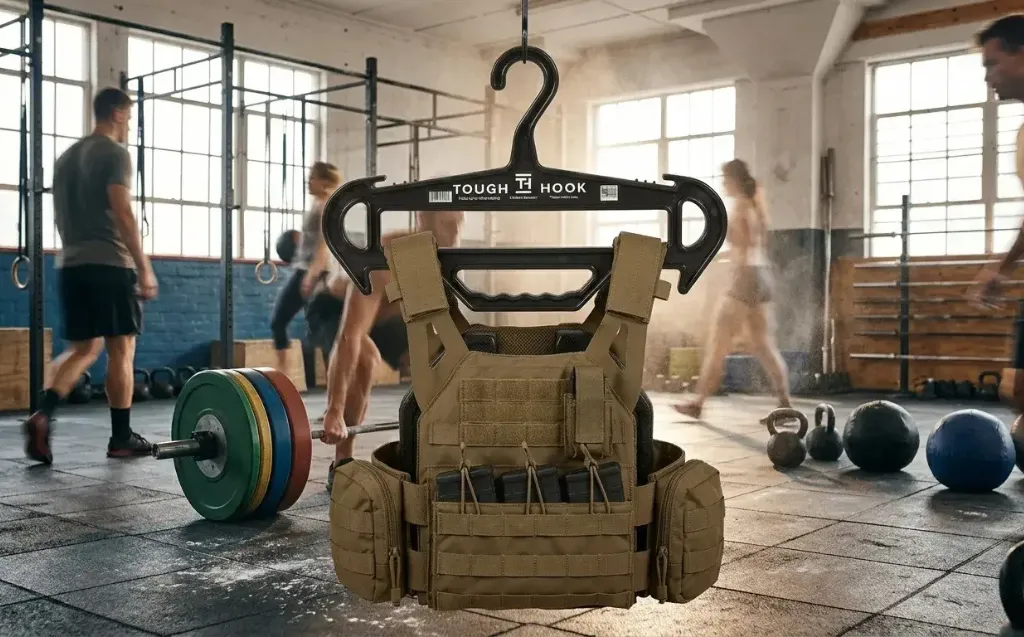
Stop Hanging Your Gear on Something That Wasn’t Built for It
You’ve invested serious money in your weighted vest, plate carrier, or tactical gear. The last thing you need is a hanger that bends under the weight, cracks over time, or lets your equipment hit the floor.
Most hangers on the market were designed for dress shirts and light jackets, not 40, 60, or 80 pounds of loaded training gear. When you force heavy equipment onto a hanger that isn’t built for the job, you’re not just risking the hanger. You’re putting stress on your vest’s straps, shoulders, and attachment points every time you hang it.
The right weighted vest hanger needs to meet a specific set of requirements: a load rating that provides real headroom, material that holds its shape under sustained stress, and a design built around how heavy gear actually behaves. This guide walks you through exactly what to look for and why it matters for anyone who takes their gear seriously.
What Is the Best Weighted Vest Hanger?
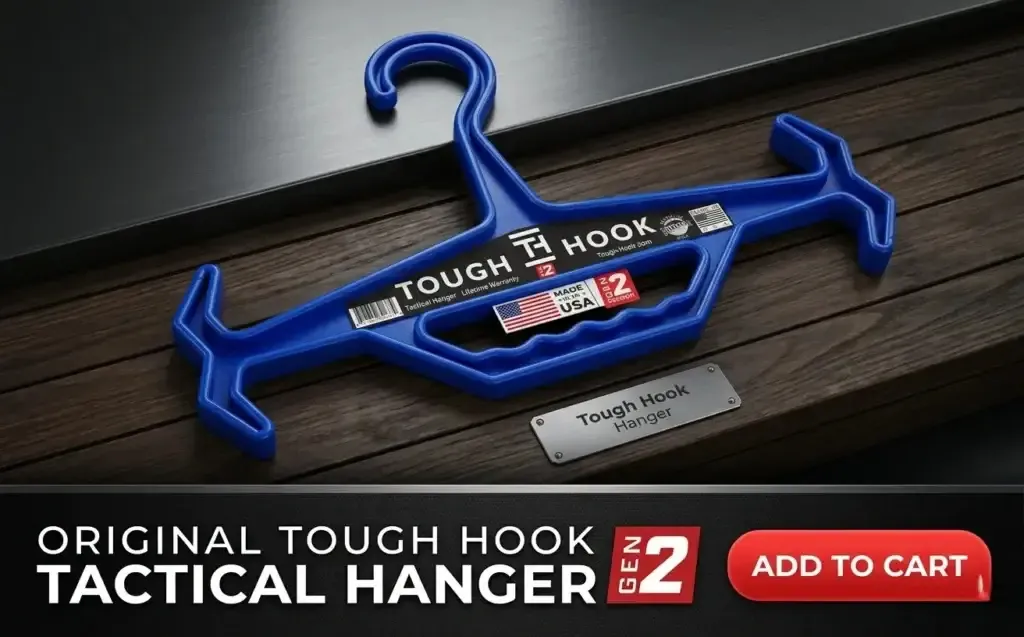
The best weighted vest hanger supports significantly more than the vest’s actual weight, distributes that load evenly across the shoulders instead of concentrating it at a single point, and resists strap deformation over months of daily use. It should work wherever you store gear, whether that’s a gym rig, a garage wall, a closet rod, or a locker. A hanger rated close to the vest’s actual weight gives you no safety margin. Tough Hook’s Original Hanger is rated to hold up to 200 lbs, well above the weight of most weighted vests, so the hanger is never operating near its limit.
Built for 200 lbs. Made in the USA.
The Original Tough Hook Hanger is engineered specifically for heavy training gear, weighted vests, plate carriers, tactical kits, and more. Polypropylene construction. Patented grip handle. Rated to hold what others can’t.
 What Separates a Real Heavy-Duty Hanger from the Rest
Not all heavy-duty hangers are actually heavy-duty. The difference shows up in how they perform over months and years of real use, not in a warehouse spec sheet. Here’s what genuinely matters when you’re storing gear that weighs as much as a small child.
1. A Load Rating With Real Headroom
A hanger rated to exactly match your gear’s weight is already operating at its limit. Every time you add a mag pouch, swap plates, or hang a second piece of kit alongside it, you’re pushing past that threshold. A proper heavy-duty weighted vest hanger should be rated well above the weight you’re actually putting on it.
Tough Hook hangers are rated to hold up to 200 lbs, providing a genuine safety margin for even the most loaded tactical or training setups. That overhead isn’t marketing; it’s the difference between a hanger that lasts years and one that gives out after months.
2. Material That Holds Its Shape Under Sustained Stress
Steel hangers rust. Cheap plastic hangers creep and deform under constant load. Neither is the right answer for gear that hangs for hours, days, or weeks between use.
Tough Hook is built from high-impact polypropylene, the same class of material used in military and industrial applications. Polypropylene resists UV degradation, moisture, and the slow deformation that cheaper plastics experience under sustained weight. It won’t rust, it won’t stain your gear, and it won’t develop sharp stress fractures the way thin steel can.
Polypropylene resists the slow deformation that cheaper plastics experience under sustained weight: no rust, no staining, no stress fractures.
The result is a polypropylene hanger that looks and performs the same in year three as it did on day one, even with heavy gear hanging on it every day.
3. A Design That Distributes Weight, Not Just Holds It
How weight sits on a hanger matters as much as how much it can hold. A narrow or poorly profiled hanger concentrates the load at a single point, which stresses your vest’s shoulder seams, distorts the shape of the carriers over time, and puts uneven pressure on the internal foam and padding.
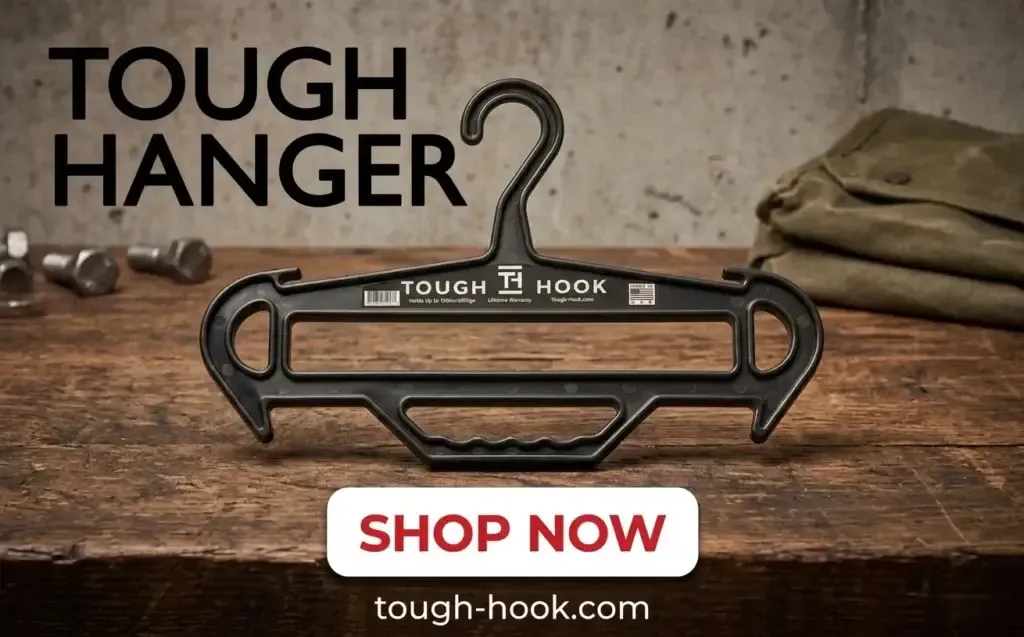
Tough Hook’s triangular frame and internal I-beam core distribute load evenly across the full shoulder span of your gear. Extension tangs at the ends of the hanger prevent straps from sliding off during storage or transport. It’s a design built around how weighted vests and plate carriers are actually constructed, not just adapted from standard clothing hanger geometry.
Carrying Larger or Bulkier Gear?
The Tough Hanger XL delivers the same 200 lb capacity and polypropylene durability in a wider profile, purpose-built for bunker gear, oversized tactical kits, and larger weighted vests that need more shoulder support.
 4. Mounting Versatility for Any Storage Setup
A great hanger only works if it fits where you need it. Whether you’re running a home gym, a commercial CrossFit box, a fire station gear room, or a tactical operations locker, your mounting setup will be different, and your hanger needs to adapt.
Tough Hook hangers slot directly into standard gym rig holes, making them a natural fit for CrossFit and strength training setups where gear needs to stay off the floor between sessions. They also work across wall mounts, standard closet rods, and vehicle transport hooks, one hanger that covers every environment you work in.
5. A Grip Handle Built for Transport Under Load
Storage is only half the picture. If you’re moving your gear between a locker, a range, a training facility, or a vehicle, you need to be able to carry it without everything sliding off or the hanger digging into your hand.
Tough Hook’s patented grip handle is purpose-designed for handheld transport under full load. At just 0.75 lbs and measuring 16″ x 1.5″ x 12″, the hanger is light enough to carry anywhere without adding meaningful weight to your kit, while the grip gives you real control whether the vest is empty or fully loaded.
6. Compatibility Across Every Type of Heavy Training Gear
Weighted vests are the obvious use case but the best heavy-duty hangers earn their place by handling everything in your gear rotation. Tough Hook is used by military and law enforcement personnel for plate carriers and duty gear, by tactical operators storing EOD and field equipment, by divers hanging wetsuits, BCDs, and full scuba rigs, and by athletes managing CrossFit vests and resistance training gear.
That range isn’t accidental. A hanger built for 200 lbs with a smart weight-distribution design naturally handles the variety of shapes, sizes, and strap configurations heavy gear comes in, without requiring a different storage solution for each item.
Heavy-Duty Hanger vs. Regular Hanger: Capacity Comparison
Not every storage option marketed for heavy gear is built the same way. The table below compares common storage methods against what a weighted vest actually requires.
| Storage Option | Typical Capacity | Best Use | Main Risk | Why It Matters |
|---|---|---|---|---|
| Regular plastic hanger | 3-5 lbs | Dress shirts, light jackets | Bends and cracks under heavy load | A loaded vest exceeds this by 10x or more on day one |
| Wire hanger | 5-8 lbs | Dry cleaning, light garments | Thin gauge concentrates load at one point | Digs into straps instead of supporting the shoulder span |
| Basic wall hook | 10-25 lbs (varies by hardware) | Light accessories, single straps | No shoulder support, vest loses shape | A hook does not distribute weight the way a shaped hanger does |
| Standard heavy-duty hanger (generic) | 20-50 lbs depending on brand | Heavier coats, light bags | Capacity varies widely, rarely tested at the high end | Many “heavy-duty” hangers are not rated for 40-80 lb loaded vests |
| NoRepGear-style weight vest hanger | 150 lbs (ABS construction, per manufacturer listing) | Weighted vests at moderate load | Less headroom above typical loaded weight | Works for most single vests but less margin with added gear |
| Tough Hook Original / Tough Hook weighted vest hanger | Up to 200 lbs | Weighted vests, plate carriers, CrossFit gear, tactical kits | None reported at rated capacity | A 40-80 lb vest operates well under the limit, not at it |
Why a Higher Capacity Rating Matters
A regular hanger bends or cracks under sustained heavy load because it was engineered for a few pounds of fabric, not 40 to 80 pounds of loaded training gear. The plastic or wire flexes every time weight is added, and that flex does not reverse itself.
Weighted vests also need load distribution, not just raw capacity. A hanger that holds the right weight but concentrates it at a narrow point still stresses the shoulder seams and stretches the straps unevenly over time. A higher capacity rating gives a safety margin that a hanger rated to exactly match your gear’s weight cannot.
How to Store a Weighted Vest Without Damaging It
Proper storage protects the parts of your vest that take the most stress: stitching, shoulder straps, padding, and any internal plates.
- Hang it from a hanger designed for heavy gear, rated well above its actual weight, with a shoulder span built to support the garment.
- Avoid thin plastic or wire hangers, which concentrate weight at a single point and eventually bend, crack, or cut into the fabric.
- Keep shoulder straps evenly supported, since uneven hanging stretches straps unevenly over time.
- Avoid storing it crumpled on the floor or in a gym bag, which compresses the padding and creases the fabric.
- Let sweat or moisture dry before long-term storage to prevent trapped moisture from breaking down padding and stitching.
- Match the storage method to your setup: a rack, closet rod, locker, wall mount, or gym rig all work, as long as the hanger is rated for the load.
For a complete routine covering cleaning and inspection alongside storage, see how to store a weighted vest for the full breakdown.
What Else Can a Weighted Vest Hanger Hold
A hanger built to support a loaded weighted vest handles a wider range of heavy gear, since the engineering challenge is the same: significant weight, an irregular shape, and straps or panels that need even support.
- Weighted vests at any load level, from light training vests to fully loaded 40-80 lb setups
- Plate carriers, where the hard plates and pouches create a similar weight and shape profile
- Tactical vests with attached pouches, mag carriers, or duty equipment
- CrossFit and strength training vests used in commercial gyms and home rigs
- Duty gear for law enforcement and first responders managing loadouts between shifts
The common thread is shoulder-span support and a capacity rating with real headroom. Browse more fitness gear storage guides for setup ideas across home gyms, CrossFit boxes, and garage rigs.
Conclusion
A weighted vest hanger isn’t a minor accessory decision. It’s the thing your most expensive training equipment rests on every day, taking on full load, resisting material fatigue, and protecting the structural integrity of gear that may cost hundreds or thousands of dollars to replace.
The criteria aren’t complicated: a real load rating with overhead, material that doesn’t degrade under sustained weight, smart weight distribution, and the mounting flexibility to work wherever your training takes you. When all four come together in one product, the choice becomes obvious.
Tough Hook is USA-made and veteran-owned, built from the ground up for the people who put the most demand on their gear and on the things that store it. It’s not adapted from a consumer product. It’s designed specifically for this job, and the 200 lb polypropylene construction shows exactly what that design philosophy looks like in practice.
Frequently Asked Questions
What weight can a Tough Hook hanger support?
Tough Hook hangers are rated to support up to 200 lbs. This provides a significant safety margin above the weight of most weighted vests, plate carriers, and loaded tactical gear, even when additional pouches, accessories, or a second piece of kit is added to the hanger.
What are Tough Hook hangers made from?
Tough Hook hangers are manufactured from high-impact polypropylene a military-grade polymer chosen for its resistance to cracking, UV degradation, moisture, and the slow material creep that affects cheaper plastics under sustained load. Unlike steel, polypropylene won’t rust or scratch your gear.
Can I mount a Tough Hook hanger on a gym rig or power rack?
Yes. Tough Hook hangers are designed to slot directly into standard gym rig holes, making them a straightforward addition to any CrossFit rig or power rack setup. They also work across closet rods and wall mount systems, so you can use the same hanger in multiple locations.
Are Tough Hook hangers suitable for plate carriers and tactical gear?
Absolutely. Tough Hook was originally designed for military and law enforcement use. The 200 lb load rating, wide weight-distribution profile, and anti-slip extension tangs make it one of the most capable options on the market for heavy-duty tactical gear storage from soft-armor carriers to fully loaded plate-carrier rigs.
How do I clean and maintain a Tough Hook hanger?
Polypropylene is non-porous and easy to maintain. Wipe down with a damp cloth to remove dirt, salt residue, or gear debris. The material won’t absorb odors or bacteria, and it doesn’t require any special treatment or conditioning. Periodically check mounting hardware and extension tangs for wear.
Can Tough Hook hangers be used for scuba and watersports gear?
Yes, Tough Hook’s resistance to moisture and UV makes it a reliable option for hanging wetsuits, BCDs, and drysuits after use. The 200 lb capacity handles fully saturated gear without issue, and the polypropylene construction won’t corrode in saltwater environments the way metal hardware can.
Is a wall hook or a hanger better for a weighted vest?
A shaped hanger generally performs better than a basic wall hook because a hook supports the vest at a single point, whereas a hanger with a proper shoulder span distributes the weight across the garment. Hooks can still work for lighter vests or as a secondary storage point, but a hanger is the better choice for a fully loaded vest.
Where should I hang my weighted vest at home?
Anywhere you already store gear works, as long as the hanger itself is rated for the load. Common setups include a closet rod, a garage wall mount, a gym rig, or a locker. Tough Hook hangers fit standard closet rods and slot directly into gym rig holes, offering flexible storage options.
Can a regular hanger hold a weighted vest?
No. A standard plastic or wire clothes hanger is rated for roughly 2 to 5 lbs, while most loaded weighted vests weigh between 20 and 80 lbs. A regular hanger can bend, crack, or drop the vest under that load, and the failure usually stresses the vest’s straps and shoulder padding. A weighted vest needs a hanger rated well above the load with a wide shoulder span, such as a 200 lb-rated Tough Hook hanger, so the weight is spread across the garment instead of concentrated at one point.