

A quality motorcycle jacket is one of the most carefully constructed pieces of protective clothing a rider owns. The outer shell, the CE-rated armor inserts, the back protector panel, the liner system, and the stitching that holds all of it together are engineered to work as a single protective unit. What happens to that unit between rides determines how well it performs when a situation demands it. Hang a 12-lb armored leather jacket on a standard wire hanger for a year, and the shoulders deform, the back panel sags, and the armor shifts out of alignment with the body zones it was designed to protect.
Finding the best hanger for heavy motorcycle jackets is not a matter of preference. It is a practical decision that directly affects the fit, the protection, and the lifespan of gear that costs hundreds of dollars to replace. The criteria are straightforward once you know what to look for, and the difference between correct and incorrect storage hardware is visible in the condition of the jacket within months of consistent use.
The Extra Width Your Jacket Actually Needs
The Tough Hanger XL is built with an extended shoulder span specifically for wide, structured outerwear. Rated to 200 lbs and constructed from high-impact polypropylene, it supports the full width of armored motorcycle jackets and riding suits without narrowing the load to a single pressure point.
 Six Things the Best Hanger for Heavy Motorcycle Jackets Must Get Right
Not all heavy-duty hangers are built equally, and not every hanger marketed toward gear storage is designed with the specific demands of motorcycle jackets in mind. These six criteria establish what genuinely separates the best option from the rest of the market.
1. Why Standard Hangers Fail Under Motorcycle Jacket Weight
The average wire hanger is rated for a few pounds at most. A textile motorcycle jacket with removable armor and a waterproof liner weighs between 6 and 10 lbs. A full leather jacket with a back protector and CE Level 2 shoulder and elbow inserts can reach 12 to 15 lbs. These loads are far beyond what standard storage hardware was designed to bear, and the failure mode is not dramatic. It is gradual. The hanger hook straightens slightly. The shoulder arms dip inward. The jacket begins resting on the hanger body rather than hanging from it, and the contact pressure concentrates at two small points on the shoulder seams.
Over weeks and months, that sustained pressure creases the leather or textile at the shoulder, compresses the padding at the contact points, and permanently deforms the jacket’s shape in ways that cannot be reversed by hanging it correctly later. Understanding what to look for when choosing a hanger for heavy outerwear prevents this kind of cumulative damage before it starts, because the correct hardware costs the same regardless of when it is purchased.
2. Weight Rating: The Number That Determines Everything Else
Every hanger claim about being heavy duty begins and ends with the weight rating. A hanger rated to 200 lbs is not overbuilt for a 12-lb motorcycle jacket. It is correctly built. The rating determines not just whether the hanger holds today, but whether it holds for the five or ten years that a quality jacket stays in rotation. A hanger operating near its limit is already under stress with every use, and material stress in hangers, whether wire, thin plastic, or pressed wood, accumulates the same way it does in any structural component under sustained load.
The practical rule is the same one that applies to any load-bearing hardware: rate for more than you need, not for exactly what you have. A 200-lb rated hanger under a 12-lb jacket has years of reliable service ahead of it. A 15-lb rated hanger under a 12-lb jacket is already working at 80 percent capacity before the jacket has been on it for a single day. When evaluating the best hanger for heavy motorcycle jackets, treat any rating below 50 lbs as a hanger built for clothing, not for riding gear.
3. Shoulder Span and How It Protects Jacket Structure Over Time
Motorcycle jackets are cut wide at the shoulders to accommodate the armor inserts and to allow a full range of motion while riding. The shoulder seams sit further out on the arm than they do on a standard garment. A conventional hanger, which narrows toward the hook, cannot support this geometry. The outer portions of the shoulder panel hang unsupported, pulling the seam inward under the jacket’s own weight and stressing the stitching at the shoulder-to-sleeve junction over time.
The best hanger for heavy motorcycle jackets has a shoulder span wide enough to reach the actual shoulder seams of the jacket, not the approximate shoulder area of a medium-weight shirt. When the hanger fills the full width of the jacket’s shoulder, the weight distributes evenly across the seam rather than concentrating at the hanger tips. This single dimension, the shoulder span of the hanger relative to the jacket, is the most underappreciated factor in long-term jacket condition. The same principle that applies to heavy tactical outerwear applies directly to armored riding jackets, because both are wide-shouldered garments engineered to carry load across the full shoulder width.
When Every Jacket in the Garage Needs Its Own Spot
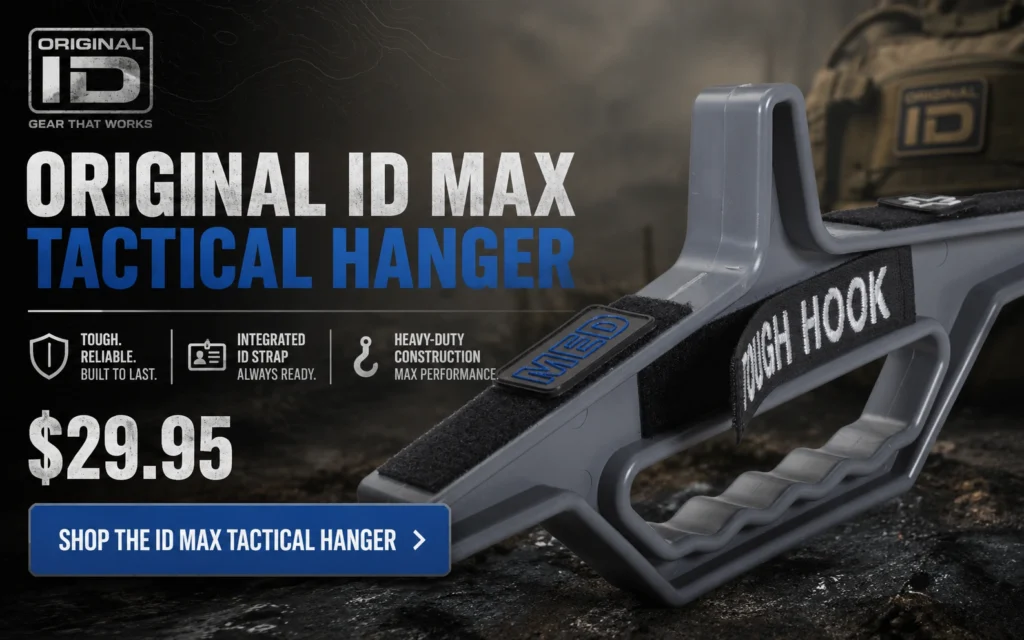
The Original ID MAX Tactical Hanger features three Velcro ID strip loops so each rider can label and locate their gear instantly. Rated to 200 lbs and built for shared storage environments, it keeps a multi-rider garage organized without the guesswork.
 4. Material: Why Polypropylene Outperforms Metal and Standard Plastic
Metal hangers corrode in garage environments where humidity fluctuates seasonally. Surface rust transfers to the interior lining of leather jackets and stains textile materials at the contact points. Thin metal also bends permanently under sustained load, which shifts the jacket’s weight distribution in ways that cannot be corrected without replacing the hanger. Standard plastic hangers crack at cold temperatures, which are common in unheated garages through winter months when the jacket may be stored for weeks at a time.
High-impact polypropylene holds its shape under sustained heavy load, does not corrode, does not crack under the temperature range of a typical garage, and does not transfer any surface residue to the jacket material. It is the material that makes a hanger genuinely suitable for long-term storage of heavy riding gear rather than just adequate for lighter daily use. The best hanger for heavy motorcycle jackets is built from polypropylene specifically because the material was engineered for exactly the conditions garage storage creates: sustained weight, temperature variation, and years of repeated use.
5. Storing a Full Riding Kit Without Disassembling It
Many riders store their jacket in its fully configured state, with liners installed, armor in place, and any attached accessories connected. This approach preserves the readiness of the kit and reduces the handling required each time the jacket goes on and off the rack. But it also means the hanger must support the combined weight of every component the jacket carries, not just the shell itself.
A hanger that can hold a bare jacket may not hold the jacket with its thermal liner, waterproof membrane, and armor all installed simultaneously. The best hanger for heavy motorcycle jackets accounts for the maximum loaded weight of the garment, not the minimum. This is also where hook integrity matters as much as hanger body construction. A hook that rotates or slides on the rack under an uneven load creates a fall risk for a jacket that may weigh more than 15 lbs fully configured. The hook should engage the rod securely and stay fixed regardless of how the weight distributes across the hanger body.
6. Matching the Hanger to the Jacket Type
Leather jackets and textile jackets have different storage requirements at the shoulder. A leather jacket is relatively stiff and holds its shape under the hanger’s support. A textile jacket, particularly one with a mesh outer layer or a soft-shell construction, is more pliable and will conform to the hanger shape over time. A hanger with a narrow or sharply angled shoulder arm creates a visible ridge in a textile jacket’s shoulder panel after extended storage, which can become a permanent crease in the material.
Matching the hanger profile to the jacket type means choosing a shoulder arm that is both wide enough and rounded enough at the top edge to support the panel without creating a pressure ridge. Knowing what specifications to prioritize before buying saves the cost of replacing a hanger that looked adequate but was not built for the specific jacket it was meant to hold. One hanger sized correctly for the heaviest jacket in the garage will also serve every lighter jacket in the rotation without adjustment.
Frequently Asked Questions
Can I use the same hanger for a leather jacket and a textile riding jacket?
Yes, provided the hanger’s shoulder span and weight rating cover both garments. A wide, high-rated hanger designed for a heavy leather jacket will support a lighter textile jacket without any issue. The reverse is not always true. A hanger sized for lighter textile gear may not have the span or load capacity to support an armored leather jacket correctly over extended storage periods.
How does a bad hanger affect the armor inserts inside a motorcycle jacket?
When a jacket sags or deforms on a hanger, the armor inserts shift within their pockets. Shoulder armor can rotate out of its designed position. Back protector panels can bow forward or to one side. Over time this affects how the armor sits against the body when the jacket is worn, which changes how impact energy is distributed in a crash. Correct hanging keeps the jacket in its design shape and keeps the armor in the position it was engineered to occupy.
Should motorcycle jacket hangers be different from regular coat hangers?
Yes. Standard coat hangers are built for garments that weigh one to three pounds. An armored motorcycle jacket can weigh four to five times that or more. The shoulder span of a standard coat hanger is also narrower than the shoulder seam placement on most riding jackets. A hanger designed for heavy outerwear, with a wider span and a weight rating that reflects real load requirements, is a different product from a standard coat hanger regardless of how similar they look.
Is it better to store a motorcycle jacket hanging or folded?
Hanging is always preferable for armored motorcycle jackets. Folding compresses the armor inserts, creases the outer material at the fold points, and puts sustained pressure on the stitching along the fold line. A leather jacket folded for an extended period will develop permanent creases that weaken the material at those lines. Hanging on a correctly rated, wide-span hanger keeps every layer of the jacket in its design configuration with no sustained pressure on any single point.
How often should I inspect a stored motorcycle jacket for condition?
A quick visual check every two to four weeks during any extended storage period is a reasonable baseline. Look for changes in shoulder shape, any visible sag in the back panel, and the position of the armor inserts relative to their labeled body zones. A full inspection including removal and check of each armor piece should happen before the jacket returns to active use after a storage period of more than a month, in line with standard guidance on gear maintenance from the Motorcycle Safety Foundation.
The Right Hanger Is the Simplest Investment in Your Gear’s Longevity
The best hanger for heavy motorcycle jackets is not an accessory. It is infrastructure. A jacket that is hung correctly on a hanger rated for its weight, with a span that matches its shoulder geometry and a material that holds up under garage conditions, stays in its design shape for as long as it remains in the rotation. A jacket hung incorrectly on hardware that was never built for its weight starts degrading from the first day it goes on the rack. The cost difference between the two options is negligible. The difference in jacket condition after two or three years of storage is not. Choose the hanger that matches the standard of the gear it holds.