
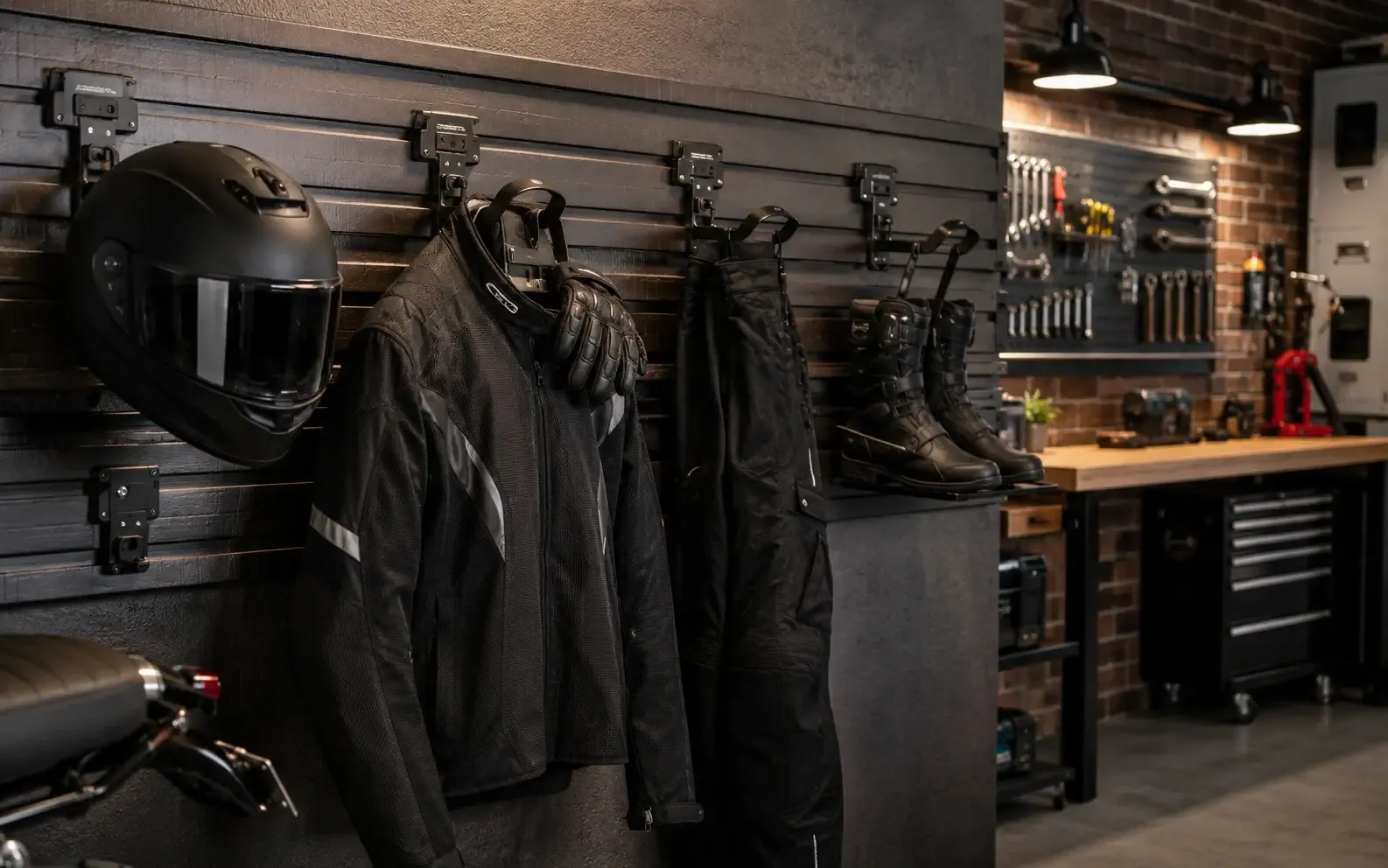
Most riders put serious thought into choosing their gear. A well-fitted jacket, a certified helmet, quality gloves, and durable boots represent a meaningful investment in both protection and performance. What happens to that gear between rides rarely gets the same attention. A jacket draped over a workbench, a helmet resting on a shelf without padding, boots kicked into a corner, and gloves stuffed into a jacket pocket are not storage solutions. They are the conditions that shorten gear lifespan, compromise structural integrity, and turn a tidy garage into a frustrating obstacle course every time you suit up.
The good news is that building an effective motorcycle gear storage system in a garage does not require a renovation. It requires a clear approach to hanging, organizing, protecting, and maintaining the individual components of a full riding kit. NHTSA guidelines on motorcycle safety consistently emphasize that properly maintained protective gear is central to rider safety – and proper storage is where that maintenance begins. The six ideas below address each gear category with practical solutions that withstand daily garage use.
A Hanger That Can Actually Hold a Riding Jacket
Leather jackets, textile riding suits, and armored gear are far heavier than standard hangers are designed to support. The Original Tough Hook Tactical Hanger is rated to 200 lbs, built from high-impact polypropylene, and designed to support the full weight and shoulder width of heavy riding gear without bending or warping.
 Six Motorcycle Gear Storage Ideas That Protect Your Riding Kit
A full motorcycle kit is a multi-component system. Each piece, from the outer jacket down to the base layer, responds differently to storage. These six ideas treat the kit as a system rather than a pile of separate items, so every piece stays in the condition it needs to be in when you reach for it.
1. Hang Jackets and Riding Suits on Hardware Rated for the Weight
A leather jacket with CE-rated armor inserts, a back protector, and a spine pad can easily weigh 10 to 15 lbs. A full one-piece riding suit weighs more. Standard plastic or wire hangers were not built for that kind of sustained load. They bend, shift the weight to a single point of contact, and leave the jacket’s shoulders in a deformed position that becomes permanent over months of storage. The result is gear that fits differently than it should and transfers load to the rider’s body in ways the armor was not designed for.
Hanging riding gear correctly means using a hanger with a weight rating that exceeds the actual load and a shoulder span wide enough to support the jacket’s structure. When the hanger matches the garment geometry, the jacket hangs in its natural shape, the armor panels stay in position, and the material retains its fit. This is the single most impactful motorcycle gear storage idea because it affects every piece of outerwear in the kit, and it costs nothing extra once the right hanger is in place. Before choosing hardware, it is worth understanding what to look for when buying hangers for heavy gear, so the decision is based on load requirements rather than appearance.
2. Dedicate a Zone to Helmet Storage
A helmet is the most safety-critical item in any riding kit and one of the most commonly mistreated during storage. Resting a helmet on a flat shelf concentrates its weight on the outer shell at a single point, which over time can create micro-compression in the EPS liner. The liner absorbs impact energy in a crash, and compression that is not visible from the outside still reduces that capacity. Stacking anything on top of a stored helmet compounds the problem.
A dedicated helmet storage zone solves this with a purpose-built helmet stand or a padded bracket mounted at head height on the wall. The helmet rests on its opening rather than on the shell, distributing weight evenly and keeping the liner in the shape it was manufactured in. If wall space is limited, a shelf with individual padded cradles for each helmet in the household keeps them organized, separated, and accessible without the stacking and shifting that leads to damage. Keep the visor down or store it separately to protect the lens from scratches and UV exposure.
3. Keep Gloves and Small Accessories Organized and Off the Floor
Gloves, balaclava liners, neck tubes, and earplugs are small enough to disappear in a cluttered garage. They end up in jacket pockets, on shelves behind other things, or on the floor where they attract oil and grit. The pre-ride scramble to locate them wastes time and puts pressure on what should be a methodical gear check before every ride.
A simple wall-mounted accessory system, whether a row of hooks, a small bin shelf, or a dedicated drawer beneath the main hanging rack, gives every small item a fixed location. Gloves, in particular, benefit from being stored flat or hung by the cuff rather than wadded up in a jacket pocket. Storing them flat allows the palm padding and knuckle armor to decompress between uses and keeps the seams from setting in a compressed position. When accessories have an assigned place, the pre-ride routine becomes a check rather than a search.
When the Garage Holds More Than One Rider’s Kit
Households with multiple riders need a storage system that scales without creating clutter. The RHINO Hanger, available in an 8-pack bundle and rated for 200 lbs per unit, provides consistent heavy-duty storage at every rack position, so every rider’s gear has a designated spot.
 4. Store Boots Upright to Preserve Their Structure
Motorcycle boots are constructed with ankle protection, toe reinforcement, and shift pad areas that depend on the boot maintaining its shape between uses. Storing boots on their sides, tossing them into a bin, or crushing them under other gear causes the shaft to fold and the internal structure to compress in directions it was not designed to flex. Over time this softens the protection where it matters most and changes how the boot fits, which affects both comfort and the security of the ankle joint in a slide.
The most effective approach is to install a dedicated boot rack near the main hanging area. Upright storage keeps the shaft straight, allows the interior to air out after a ride, and makes both boots immediately visible and accessible. Boot trees, even inexpensive adjustable ones, help maintain the shaft’s shape during extended storage. If floor space is limited, a two-tier boot shelf mounted to the wall takes up the same footprint as a single pair lying flat while holding two or more pairs vertically.
5. Separate Base Layers and Textile Liners from Outerwear
Many riding jackets and pants include removable thermal liners, waterproof membranes, and mesh inner layers that can be used independently, depending on conditions. Storing these liners stuffed inside the outer shell keeps the shell in a semi-compressed state, traps any residual moisture from the liner between two layers of material, and makes it impossible to assess either piece at a glance before a ride.
Removing liners before storage and hanging them separately solves all three problems. The outer shell hangs in its natural shape. The liner airs out fully and is visually accessible. Both pieces are ready to be deployed together or independently based on the day’s conditions. Organizing gear by component type rather than by outfit is the approach that scales best when a kit grows to include gear for multiple seasons or riding styles.
6. Protect Gear from Garage Humidity and Temperature Swings
A garage is not a stable environment. Temperature drops at night can create condensation on gear stored near exterior walls or concrete floors. Summer heat in enclosed spaces accelerates the breakdown of leather conditioners, adhesives used to attach armor, and the foam padding inside helmets and back protectors. Dust and airborne grease from tools and vehicles settle on stored gear and work their way into the stitching and material over time.
Positioning the gear storage area away from exterior walls and off the floor reduces exposure to condensation and ground-level temperature extremes. Breathable garment covers protect hanging jackets and suits from dust without trapping moisture, as plastic dry-cleaning bags do. A small dehumidifier running during humid months makes a measurable difference in how leather and textile gear ages in a garage environment. These environmental controls cost less than a single piece of replacement gear and extend the service life of everything in the kit.
Gear That Is Stored Well Performs Well
Motorcycle gear does its job in the moment it is needed most. How well it does that job depends largely on how deliberately it has been maintained during the hours and days it spends in the garage between rides. Hanging systems that match the weight and geometry of riding gear, dedicated zones for helmets and boots, organized accessory storage, and environmental controls that keep moisture and temperature in check are not optional upgrades. They are the baseline conditions for gear that maintains its protection rating, fits as designed, and is ready without compromise every time you suit up. Build the storage system around the gear, and the gear will return that investment on every ride.
Frequently Asked Questions
How should a leather motorcycle jacket be stored long term?
Hang it on a wide, weight-rated hanger in a cool, dry area away from direct sunlight and heat sources. Apply a leather conditioner before extended storage to prevent the material from drying out and cracking. Remove any removable armor and store it separately so it does not compress the jacket’s shoulder and back panels over months of non-use. A breathable garment cover keeps dust off without trapping moisture against the leather.
Is it safe to store a motorcycle helmet on a standard shelf?
A flat shelf is not ideal because it rests the helmet’s weight on the outer shell rather than distributing it through the opening. Over time, this can compress the EPS liner at the contact point. A dedicated helmet stand that supports the helmet through its opening is a better solution. If shelf storage is the only option, use a padded cradle that cups the helmet at the opening rather than at the crown or sides.
How do I stop my garage gear storage area from becoming cluttered again?
Every item needs a fixed, designated location to return to after every ride. The most common cause of recurring clutter is a system where some items have assigned spots and others do not. Accessories that lack a specific hook, bin, or shelf tend to migrate to the nearest surface. Assign a location to every item in the kit, including small ones, and the system maintains itself as a habit rather than requiring periodic reorganization.
Can textile riding gear be stored the same way as leather?
Yes, with one additional consideration. Textile gear often includes waterproof membranes that benefit from being stored uncompressed and fully open so the membrane can breathe. Textile jackets and pants hung flat on a wide hanger in a ventilated area stay in better condition than those folded or compressed. Check the manufacturer’s care instructions for any specific storage restrictions related to the waterproofing treatment used on the outer fabric.
How much wall space does a functional motorcycle gear storage setup require?
A single rider’s full kit, jacket, pants, helmet, gloves, and boots, can be organized in a wall footprint of roughly four to six feet wide and six feet tall. That includes a hanging rack for outerwear, a helmet stand or bracket, a boot rack at floor or shelf level, and a small accessory hook system for gloves and liners. Households with multiple riders scale the footprint proportionally, and a rack system using consistent heavy-duty hangers keeps the full setup organized without wasted space.