
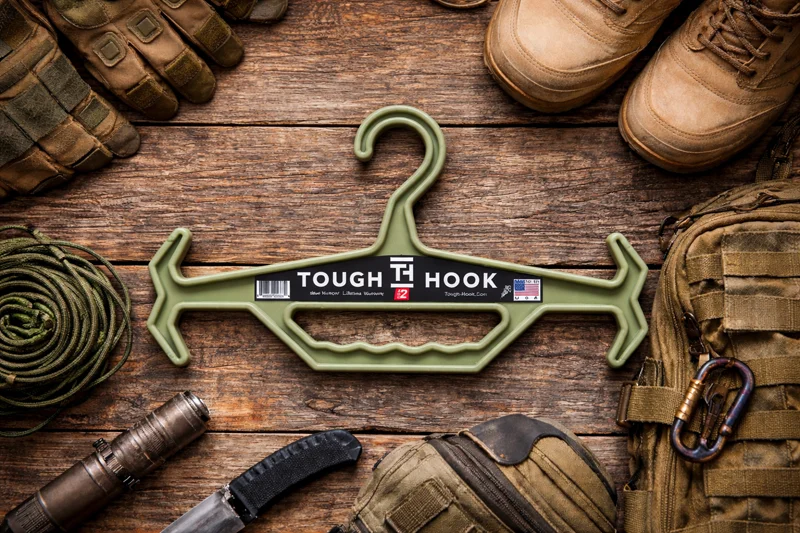
Most people spend more time choosing a phone case than they do choosing a hanger. And then they wonder why their closet is a mess, their clothes lose their shape, and they have to replace broken hangers every few months. The truth is that buying the wrong hanger is one of the most common and easily avoidable household mistakes. The right hanger protects your clothes, keeps your closet organized, and lasts for years without a second thought. The wrong one does the opposite quietly and consistently. Before you buy another pack of hangers, here are seven things you genuinely need to know.
Built for Real Closets, Not Cheap Ones
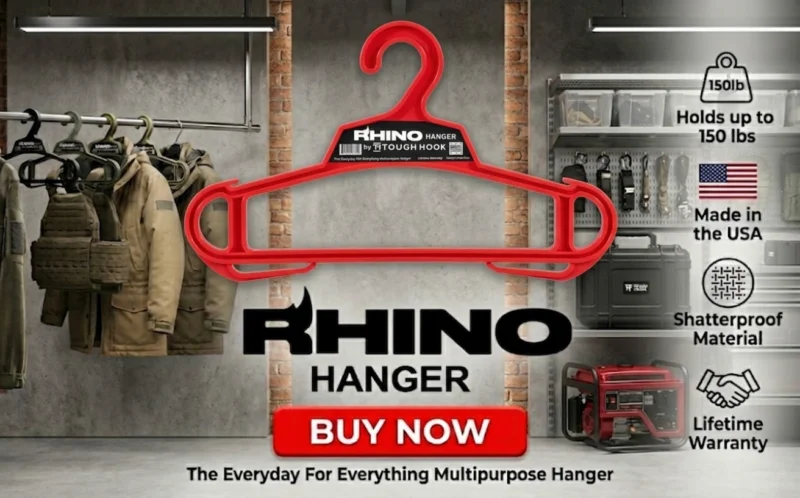
If your closet holds anything heavier than a dress shirt, it deserves a hanger built for the job. The RHINO Hanger is the ultimate everyday hanger for heavy clothing and general home use, with wide arms, solid construction, a 200-lb rating, and a lifetime warranty. Made in the USA. See the RHINO Hanger here before you settle for anything less.
Why Most People Buy the Wrong Hangers
The average person buys hangers based on two things: price and quantity. The more hangers per dollar, the better the deal. This logic works fine for paper towels. It does not work for something that holds your clothing, gear, and outerwear day after day under constant load.
Cheap hangers are designed to a price point, not a performance standard. They bend under weight, crack in temperature extremes, scratch fabric, and distort the shape of anything heavier than a lightweight shirt. The real cost of cheap hangers is not the purchase price it is the clothing damage, the constant replacements, and the closet that never quite works the way it should. Buying hangers the right way starts with knowing what actually matters. Here are the seven things that do.
What to Know Before You Buy Any Hanger
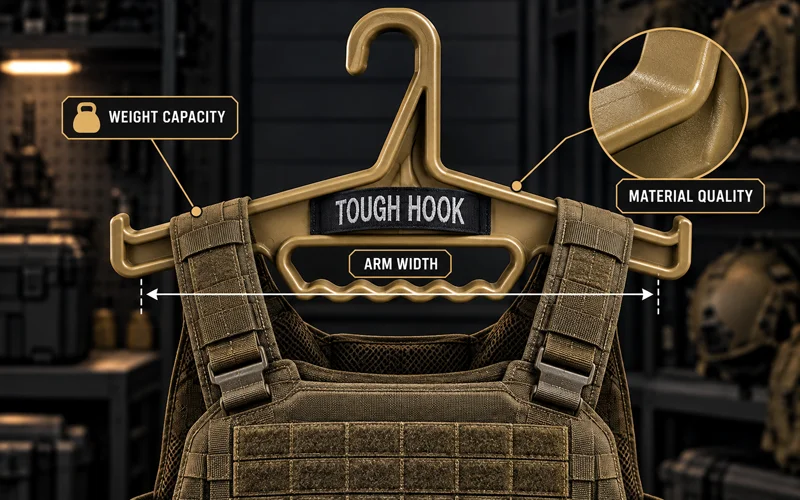
Choosing the right hanger is simpler than it sounds once you know what to look for. These seven factors cover everything from load capacity to long-term value, and getting them right makes every other part of closet organization easier.
1. Weight Capacity Is the Most Important Number
Every hanger has a load limit; most people just never check it. Standard plastic hangers typically handle 2–5 lbs, which is adequate for lightweight shirts but completely inadequate for anything heavier.
Before buying, think about the heaviest item you plan to hang:
- A thick winter coat runs 5–8 lbs
- A leather jacket weighs around 8–12 lbs
- Tactical gear, plate carriers, and duty vests can exceed 30–40 lbs
Match the hanger’s rated load capacity to your heaviest item and always buy with a margin above that weight, not right at it. If you want a closer look at how different materials hold up under load, how many pounds a plastic hanger can hold breaks it down by hanger type.
2. Arm Width Determines How Well Your Clothes Keep Their Shape
A hanger that is too narrow for the item it holds creates two pressure points at the tips of the arms, and everything between those points sags. Over time, this distorts shoulder seams, stretches necklines, and permanently alters the drape of structured garments.
Wide, contoured arms distribute the weight of a garment evenly across its full shoulder span, which is exactly how clothing is designed to be supported. For coats, jackets, suits, and anything structured, arm width is just as important as load capacity.
For reference, most standard adult hangers measure about 17 to 18 inches across the arms, sized for an average shoulder span, with a drop of roughly 8 to 9 inches from the hook to the bottom of the arms. Extra-wide, heavy-duty styles built for coats, suits, and bulkier garments typically run 19 to 21 inches across the arms, giving broader shoulders and structured jackets the extra support they need.
3. Material Quality Determines How Long It Lasts
Not all plastic is the same. The thin polystyrene used in budget hangers cracks under load, becomes brittle in cold environments, and deteriorates with UV exposure if stored in garages or outdoor areas. High-density, impact-resistant polymer behaves completely differently; it holds its shape under sustained load, handles temperature extremes, and does not degrade with time.
When evaluating a hanger, check whether the material specification is listed. Vague descriptions like “durable plastic” are a red flag. Specific terms like impact-resistant resin or high-density polymer indicate a hanger actually engineered for performance. For a closer look at what to check before you buy, see how to choose plastic coat hangers.
4. Hook Design Affects Both the Hanger and Your Closet Rod
The hook is the single point where all the load is transferred from the hanger to the rod, making it the most structurally critical part of the entire hanger. A weak hook bends under sustained load, a narrow hook opening cannot fit thicker rods, and a hook without a smooth finish will scratch and damage your closet rod over time.
Look for a reinforced hook neck, a smooth finished surface, and an opening wide enough to accommodate your specific rod diameter. If you have ever had a hanger that would not sit flat on the rod or kept sliding to one side, a poorly designed hook was almost certainly the reason. For more on what proper construction looks like, read Built to Last: What to Look for Before Buying Heavy-Duty Hangers.
When Your Gear Needs More Than a Standard Hanger
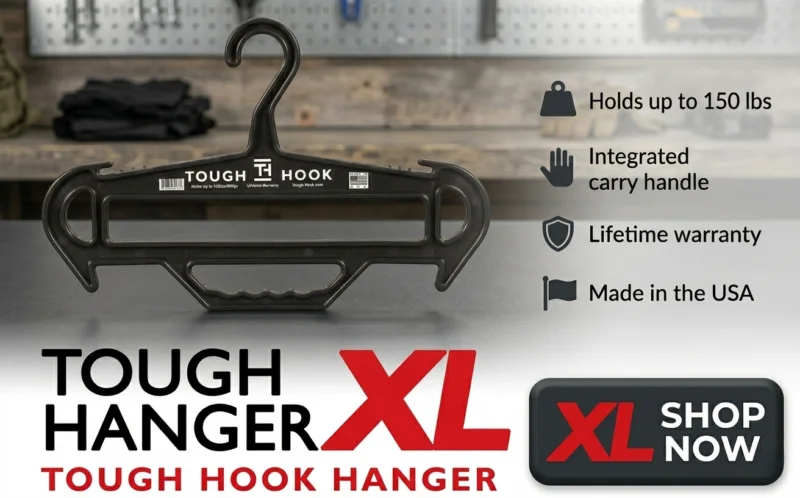
Some items demand serious support: tactical vests, heavy outerwear, plate carriers, and loaded duty gear need a hanger that will not flinch under the weight. The Tough Hanger XL is our largest and most capable hanger, with an integrated carry handle, rated to 200 lbs, and built in the USA for exactly this kind of load. Get the Tough Hanger XL here and stop worrying about what your hanger can handle.
5. Consistency Across Your Closet Matters More Than You Think
Buying hangers in mixed styles, some velvet, some plastic, some wire, some wooden, creates a closet that looks disorganized even when everything is technically hung up. Different thicknesses and widths mean items hang at different heights, spacing becomes uneven, and the visual result is chaos, regardless of effort.
Switching to a single, consistent hanger type throughout your entire closet is the fastest visual upgrade most people can make. Everything hangs at the same height, spacing becomes natural, and the whole closet looks more structured without any additional organization system. As shown in Seasonal Swap Made Easy: Rotating Heavy Clothes the Smart Way, consistency in your storage approach pays dividends every time you rotate your wardrobe.
6. Think About the Specific Environment You Are Storing In
Where your hangers live matters as much as what they hold. A residential bedroom closet has different demands from a garage storage system, a precinct gear locker, a firehouse equipment room, a hotel or bed-and-breakfast guest closet, or a field storage setup.
Humid environments require hangers that will not rust or corrode, ruling out wire and most metal options. Temperature-variable environments, such as garages or outdoor storage, require impact-resistant materials that remain structurally sound across a wide thermal range. High-demand professional environments require hangers that can withstand rough daily use without cracking or deforming. Match the hanger to the environment, not just to the clothing. For professionals in high-demand settings, Gear Accountability: Keeping Track of Equipment in High-Pressure Environments covers how proper storage supports operational readiness.
7. Long-Term Value Beats Upfront Price Every Time
A pack of 50 cheap hangers for a few dollars looks like a bargain. Factor in that they snap within months, need regular replacement, and damage the clothing they hold, and the calculation changes completely.
A smaller number of well-built hangers that last for years, protect your clothing, and never need replacing costs less over any meaningful time horizon than an endless cycle of cheap replacements. The right hanger is not an expense it is a one-time decision that pays for itself in clothing longevity, organizational consistency, and complete freedom from ever thinking about hangers again. See how this plays out in practice in heavy-duty hangers compared to regular hangers, and as we covered in Sustainable Storage: Choosing Hangers That Last for Years, durability is the most sustainable and cost-effective choice you can make.
How Many Hangers Does the Average Household Actually Need?
There is no single number that fits every closet, because it depends on what is actually hanging in it, not on some fixed average. Instead of guessing, walk your closet in categories: shirts and blouses, pants and skirts, dresses, and structured pieces like blazers, coats, and outerwear. Count what is currently on the rod, then add a modest buffer for new purchases and gifts so you are not short a hanger the next time you unpack a bag.
Two adjustments matter more than the total count. First, set aside a small group of heavy-duty hangers specifically for your heaviest items, coats, tactical gear, or duty equipment, rather than forcing them onto the same lightweight hangers you use for everyday shirts. Second, leave breathing room on the rod itself. Overcrowded hangers compress against each other, which wrinkles fabric and makes it harder to see what you own. A closet that is sized correctly for its contents, with a little slack built in, stays organized with far less daily effort than one that is simply full of hangers.
Standard Hanger Dimensions: Length, Width, and Drop
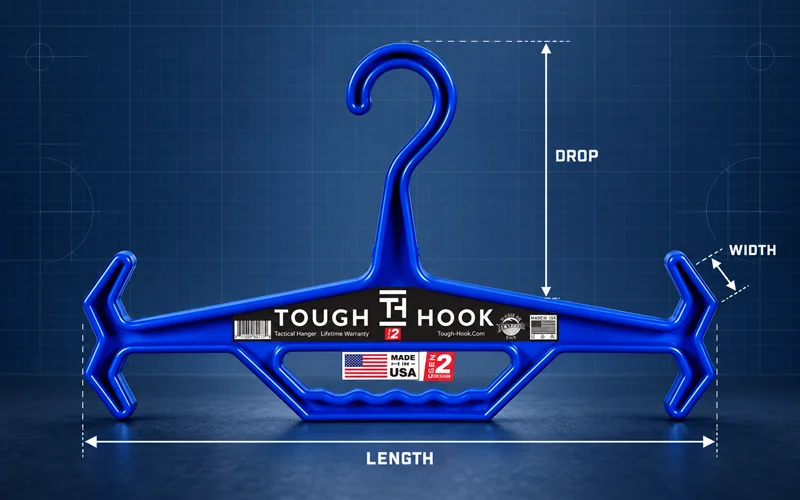
Hanger size is usually described two ways: the width, or length, across the arms, and the drop, which is the vertical distance from the hook to the bottom of the arms. Knowing both numbers matters when you are replacing old hangers, since a mismatch in either dimension is exactly what causes the sagging and pressure points described above.
A standard adult hanger runs about 17 to 18 inches across the arms with a drop of roughly 8 to 9 inches, which is sized for an average shoulder span on shirts, blouses, and lightweight jackets. Heavy-duty and extra-wide hangers built for coats, suits, and bulkier garments typically extend to 19 to 21 inches across the arms to support a broader shoulder span without the fabric slipping or bunching at the tips. When you are unsure which size fits your closet, measure your widest garment’s shoulder seam and match the hanger to it, not the other way around.
Types of Hangers and What Each One Is Best For
Not every hanger is built for the same job, and knowing the tradeoffs of each type makes it easier to pick the right one for a given closet.
- Heavy-duty plastic hangers offer the best all-around mix of strength, moisture resistance, and load capacity, which is why they work for everything from everyday shirts to coats and gear.
- Wooden hangers have a premium look and enough rigidity for suits and jackets, but they can warp or swell in humid conditions and take up more closet space than slimmer designs.
- Velvet hangers use a thin, non-slip surface that grips lightweight fabric well, which makes them a good fit for delicate blouses and slippery materials, though they offer little structural support for anything heavier.
- Padded hangers add a soft, cushioned surface that protects delicate or structured garments, such as evening wear or blazers, from crease marks and shoulder indentations.
- Wire hangers are the least durable option. They bend under load, offer no shoulder support, and are the type most likely to leave the pressure-point damage described earlier in this guide.
For most closets, a single heavy-duty hanger type covers everyday clothing and outerwear alike, with velvet or padded hangers reserved for a smaller group of delicate items.
Conclusion
You came here knowing something was wrong with your current hangers. Now you know exactly why and exactly what to do about it. Weight capacity, arm width, material quality, hook design, consistency, storage environment, and long-term value. Seven factors that most people never consider, and every person who has ever snapped a hanger under a heavy coat wishes they had.
Get these seven things right, and your closet works better, your clothes last longer, and you never have to think about hangers again. That is the entire point: one smart decision that permanently removes the problem. Tough Hook hangers are made in the USA by veterans, rated to hold up to 200 lbs, built from 100% recyclable, eco-friendly materials, and backed by a lifetime warranty. Browse the full Tough Hook lineup and see which hanger fits your closet.
Frequently Asked Questions
Q1. How do I know which weight-capacity hanger I need?
Start with the heaviest item you plan to hang and add a 20–30% margin above that weight. For everyday clothing, a hanger rated for 20–50 lbs is usually sufficient. For heavy coats, tactical gear, or duty equipment, you need a hanger rated for at least 150 lbs, ideally 200 lbs, to ensure it holds safely under sustained load without degrading.
Q2. Are plastic hangers better than wooden or velvet hangers?
It depends entirely on the application. Velvet hangers grip lightweight clothing well but offer almost no structural support for heavier items. Wooden hangers look premium but can warp with humidity. High-quality heavy-duty plastic hangers offer the best combination of structural strength, moisture resistance, and load capacity, making them the most versatile choice for a wide range of clothing and gear. For a step-by-step look at what separates a good one from a bad one, see choosing quality plastic hangers.
Q3. How many hangers does the average person need?
One hanger per item currently in your closet, plus 10–15% extra for new additions. More importantly, never crowd your rod items; they need approximately 1 inch of spacing to hang freely and remain accessible without bunching.
Q4. Does hanger arm width really affect clothing shape?
Yes, significantly. A hanger arm that is too narrow for a garment creates concentrated pressure points at the arm tips, which can deform shoulder seams and stretch the fabric over time. Wide, contoured arms that match the item’s shoulder span distribute the load evenly and preserve the garment’s original shape indefinitely.
Q5. What are the standard dimensions of a hanger?
A standard adult hanger measures about 17 to 18 inches across the arms, sometimes referred to as its length or width, with a drop of roughly 8 to 9 inches from the hook to the bottom of the arms. Heavy-duty and extra-wide hangers built for coats, suits, and bulkier garments typically extend to 19 to 21 inches across the arms to support a broader shoulder span.
Q6. Should I buy padded hangers instead of standard ones?
Only for a specific subset of your closet. Padded hangers are worth using for delicate or structured pieces, such as evening wear, blazers, and blouses, where a cushioned surface prevents crease marks and shoulder indentations. For everyday clothing, coats, and heavier gear, a heavy-duty hanger with a wide, contoured arm still offers better support and durability.