
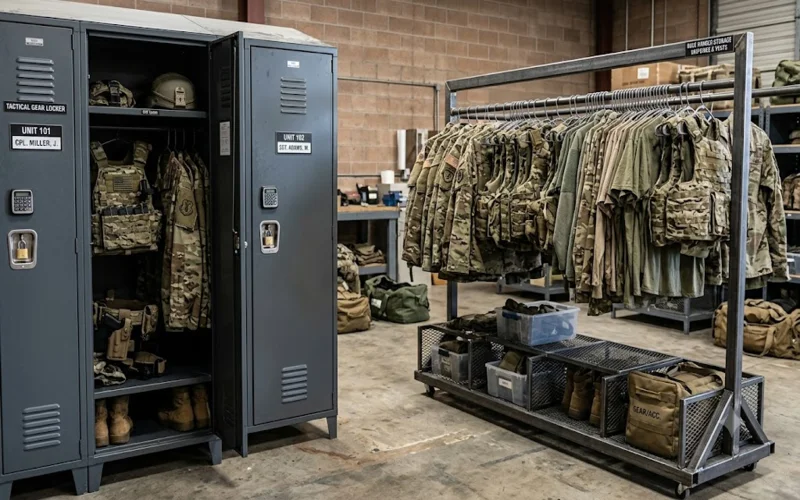
A shared gear room rarely fails because of one bad hanger. It fails because dozens of hangers, bought at different times from different sources, reach the end of their usefulness at once. Shoulders sag under the weight of body armor, hooks bend on rails they were never sized for, and staff starts improvising with whatever is left in the supply closet.
For law enforcement, fire departments, military units, and training facilities, that slow breakdown has real operational costs. Gear that is not stored properly wears out faster, takes longer to locate during a shift change, and ends up piled on a bench instead of hanging and ready. This guide walks through what makes gear locker storage different from a household closet, and how agencies can approach bulk hanger procurement in a way that scales across an entire department rather than one locker at a time.
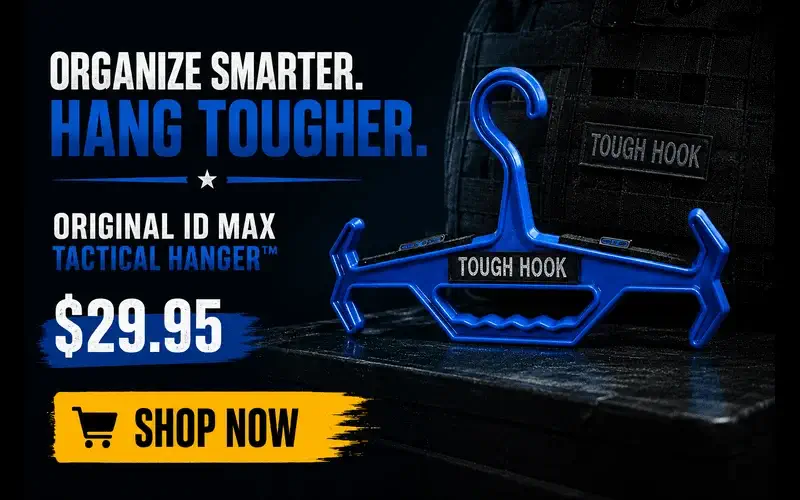
Agencies managing multiple lockers or bays often need a way to tell gear apart at a glance. The Original ID MAX Tactical Hanger adds Velcro identification strips directly to the hanger for exactly that purpose.
What Makes Gear Locker Organization Different From Home Closets
A household closet holds shirts, coats, and the occasional heavy jacket. A gear locker holds body armor, duty belts, turnout gear, bags, and uniforms that are handled daily and often weigh far more than typical clothing. The storage solution has to account for that difference in both weight and frequency of use.
Creating a dedicated tactical gear storage space usually means planning around rail height, hook spacing, and airflow rather than simply adding more hangers to an existing rod. Multiply that by dozens or hundreds of personnel, and the margin for error in hanger selection gets much smaller.
Why Standard Storage Solutions Break Down in Shared Gear Rooms
Gear locker hangers get handled more often and by more people than a hanger in a home closet ever would. Equipment turns on and off multiple times per shift, and it is rarely at full light. A hanger built for a dress shirt has no realistic chance of holding up under that kind of repeated, heavy use.
The failure pattern is predictable. Hooks bend on rails that are thicker than a standard closet rod. Shoulders on thin hangers deform under the weight of loaded vests and duty gear. Wooden hangers, when used at all, swell and warp in gear rooms that are not always climate-controlled. Proper storage for body armor and equipment depends on hardware that can withstand daily wear without requiring replacement every few months.
Features That Matter for Locker Room and Rack Hardware
Hanger Spacing and Rail Compatibility
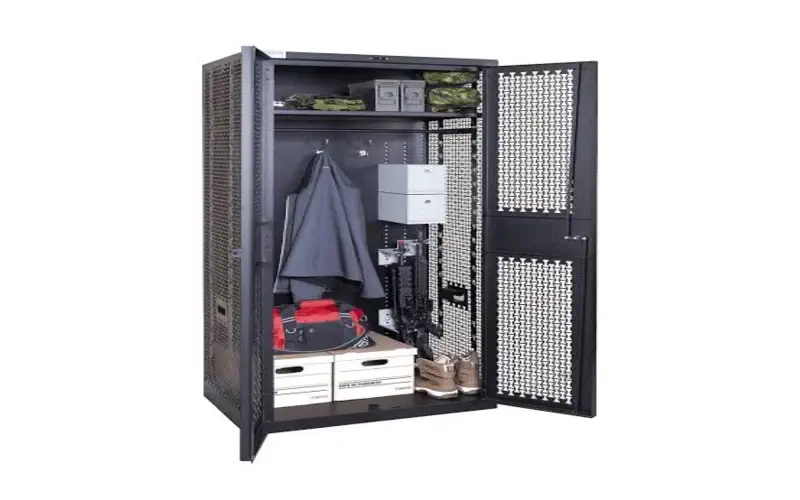
Locker rooms and gear rooms often use thicker rails or pipe racks instead of standard closet rods. A hook that fits a home closet may not clear an industrial rail at all. Spacing also matters at scale, since hangers that are too wide reduce how much gear fits in a fixed amount of rack space, a common constraint covered in these law enforcement locker organization tips for departments working with limited square footage.
Hook Size and Load Handling
A wider, reinforced hook holds up better under constant loading and unloading than a thin, tightly curved one. This becomes more important in shared spaces where the same hanger might be used by different personnel across shifts, each adding their own gear without necessarily handling it gently.
Ventilation and Airflow
Gear that comes in wet, sweaty, or contaminated needs airflow around it to dry and off-gas properly before the next use. A hanger that holds a garment away from the wall or from other gear, rather than compressing it against neighboring items, supports that airflow instead of trapping moisture against the fabric. This is especially relevant for fire departments working out how to store turnout gear between shifts, since gear that stays damp against a wall or locker door dries more slowly and wears faster.
Labeling and Identification
In a locker shared by multiple people or a rack used by an entire shift, identifying which hanger belongs to which set of gear saves real time. Hangers with a built-in space for a name strip or ID patch remove the guesswork that comes with rows of identical uniforms.
Procurement Considerations by Agency Type
| Agency Type | Typical Priority | Storage Consideration |
| Law enforcement | Fast access during shift changes | Duty belt and vest weight, locker width |
| Fire departments | Ventilation for turnout gear | Airflow, avoiding prolonged UV exposure |
| Military units | Standardization across units | Uniform hook size, consistent rail spacing |
| Security teams | Durability under frequent handling | Hook and shoulder strength over time |
| Training facilities | High turnover of users | Simple replacement, labeling for rotation |
Estimating Quantity Requirements and Planning for Replacement
Start with headcount, then add a buffer. Ordering exactly one hanger per current staff member leaves no room for new hires, damaged units, or gear that needs two hanging points instead of one. Most procurement teams find it more efficient to round up to the nearest bulk pack size rather than order a precise, unrounded quantity.
Replacement planning matters just as much as the initial order. Staff turnover, seasonal hiring, and equipment upgrades all create ongoing demand. Building a small reserve into the initial order, rather than placing a new purchase order every time a handful of hangers are needed, tends to reduce both cost and administrative overhead over time.
For departments that order in volume, the RHINO 8 Pack Clothes Hanger Bundle offers a straightforward way to stock multiple lockers or bays with a single order.

Standardizing Equipment Across Departments
Mixed hanger types across different units or stations create small but real inefficiencies. Replacement parts, bulk reorders, and even basic locker inspections all become more complicated when every department uses different hardware. Standardizing on a single hanger type across an agency simplifies inventory tracking and makes it easier to compare wear and replacement rates over time, which is part of why re-engineering a gear room for multi-unit departments usually starts with picking one hanger specification before touching the rack layout itself. Standardization also supports a more consistent appearance across uniformed spaces, which many agencies value independent of the practical storage benefits.
Budget, Lifecycle Value, and Procurement Documentation
Purchase price is only part of the real cost of outfitting a gear room. A cheaper hanger that fails within a year and needs to be reordered can cost more over time than a higher-rated hanger that lasts significantly longer. This is the same logic behind life cycle costing, a procurement approach the U.S. Government Accountability Office has described as a way to evaluate the total cost of a product across its useful life rather than its price alone.
Documentation matters for approval as well. Agencies typically need clear unit pricing, bulk order quantities, and shipping timelines to move a purchase through internal review. Building that information into the initial procurement request, rather than gathering it after the fact, tends to shorten approval cycles considerably.
Common Procurement Mistakes Agencies Make
Ordering the exact headcount with no buffer is one of the most frequent errors, since it guarantees a follow-up order within months. Mixing hanger types across departments to save a small amount upfront is another, since it creates long-term inventory complexity. Some agencies also treat hanger procurement as an afterthought within a larger equipment order, which can result in a mismatch between the hangers purchased and the actual rail or rack hardware already installed.
Bulk Procurement Checklist
- Confirm current headcount and add a reasonable buffer for turnover
- Measure existing rail or rod thickness before ordering
- Decide whether labeling or identification features are needed
- Compare bulk pack pricing against per unit pricing
- Request documented shipping timelines for budget planning
- Standardize hanger type across departments where practical
Questions Agencies Should Ask Before Placing an Order
Before finalizing a bulk order, procurement teams should confirm the rated load capacity against the heaviest gear that will actually be hung, not just the average load. It is worth asking whether the supplier offers consistent bulk pricing at the quantities the agency actually needs, rather than only at volumes far beyond current requirements. Shipping timelines, minimum order quantities, and whether replacement units can be reordered individually are also worth confirming before the purchase order is finalized.
Building a Gear Room That Holds Up
Outfitting a gear locker or equipment room is less about finding the cheapest hanger available and more about matching hardware to how the space is actually used. Agencies that plan for headcount, rail compatibility, ventilation, and labeling from the start tend to spend less over time than those that replace mismatched hangers piecemeal.
Bulk hanger procurement works best when it is treated as its own line item rather than an afterthought tucked into a larger equipment order. Tough Hook’s heavy-duty hangers, built in Bozeman, Montana, are designed for exactly this kind of daily, high-load use, giving agencies a straightforward way to standardize gear storage across an entire department.
Frequently Asked Questions
How many hangers should an agency order for a gear room?
A reasonable starting point is current headcount plus a buffer of ten to twenty percent to account for new hires, damaged units, and gear requiring more than one hanging point. Ordering in bulk pack sizes rather than an exact unrounded number also tends to simplify both pricing and future reorders.
What is bulk hanger procurement and why does it matter for agencies?
Bulk hanger procurement refers to purchasing hanging storage hardware in volume for an entire department or facility rather than a single locker. It matters because agencies benefit from consistent hardware, simplified reordering, and better pricing when hangers are standardized and purchased at scale instead of picked up individually as needed.
Can standard hangers hold body armor and duty gear?
Standard hangers designed for light clothing are generally not designed to support the sustained weight of body armor, loaded duty belts, or turnout gear. Reinforced hangers with a higher load rating and a wider hook are better suited to equipment that is heavier and handled more frequently than typical clothing.
How often should gear locker hangers be replaced?
Replacement timing depends heavily on load and frequency of use rather than a fixed calendar schedule. Hangers showing bent hooks, cracked necks, or visible shoulder deformation should be replaced regardless of age, as continued use of damaged hardware increases the risk of gear failure or becoming misshapen.
Should every department in an agency use the same hanger type?
Standardizing on one hanger type across departments generally simplifies inventory management, bulk reordering, and replacement planning. It also makes it easier to track wear patterns and budget for future purchases, since procurement teams are working with a single specification rather than several different products.
What should be included in a bulk hanger purchase request?
A complete request typically includes the required quantity, current rail or rod dimensions, any labeling or identification requirements, and a comparison of bulk versus per-unit pricing. Including expected shipping timelines up front also helps move the request through internal approval without follow-up delays.