
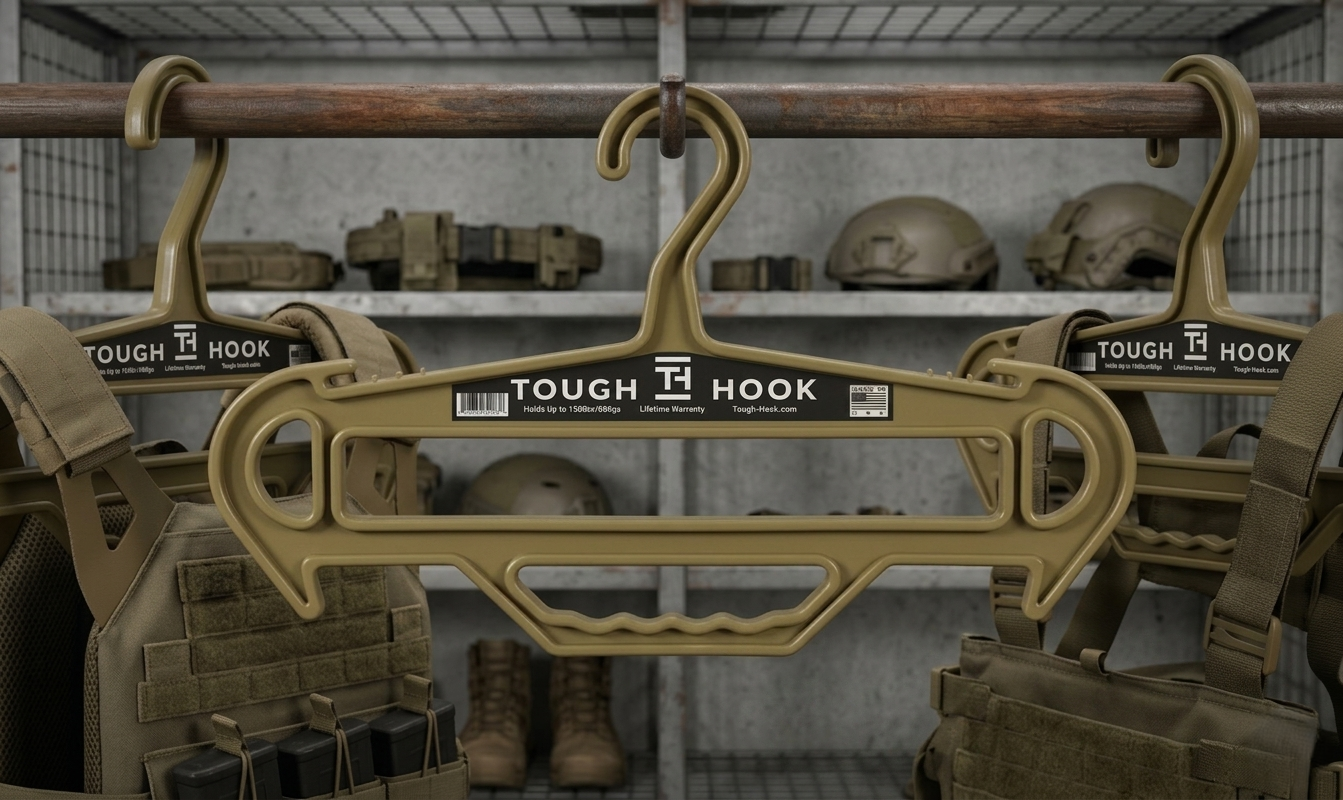
Tactical gear does not forgive bad storage. A plate carrier dumped on a chair overnight loses its shape. A duty vest folded over a shelf compresses the padding, shortening its lifespan. And a standard plastic hanger? It snaps the moment you load anything serious onto it, usually at the worst possible time.
If you carry gear for a living or depend on it when it matters most, the hanger holding that gear between shifts is not a small decision. This guide covers exactly what to look for in Heavy Duty Plastic Hangers built specifically for tactical gear, and why getting this right protects both your equipment and your readiness.
This Is What Tactical Gear Storage Should Look Like
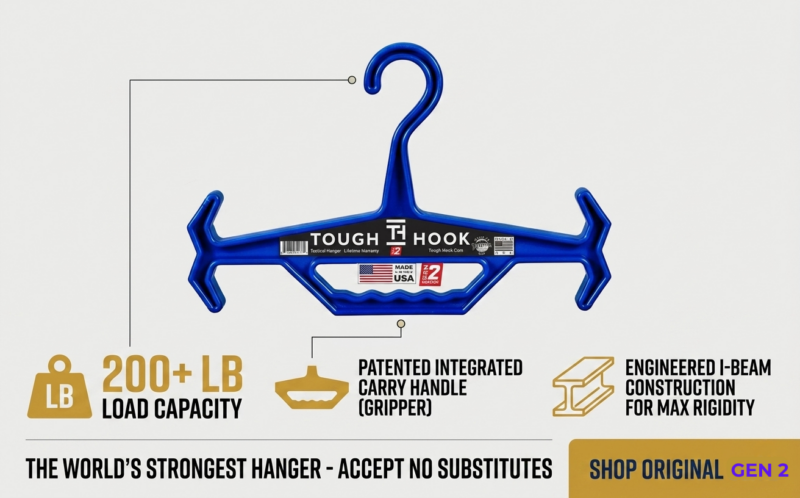
The Original Tough Hook Tactical Hanger was purpose-built for exactly this — plate carriers, body armor, duty vests, and heavy tactical equipment. Rated to 200 lbs. Made in the USA by veterans. Features an integrated GEN 2 gripper handle and an upgraded neck opening that fits wider closet rods. Get the Original Tough Hook Tactical Hanger here.
Why Standard Hangers Fail Tactical Gear Every Time
Walk into most locker rooms, precinct storage areas, or military billets, and you will still find standard plastic hangers struggling under the weight of gear they were never designed to hold. The results are predictable: bent arms, cracked hooks, vests sagging into unnatural positions, and plate carriers slowly losing their structural integrity over months of improper storage.
Standard plastic hangers are engineered for clothing that weighs under 5 lbs. Tactical gear starts at 10 lbs and regularly exceeds 40 lbs when fully loaded. That gap in load capacity is not a minor inconvenience; it is the difference between gear that stays mission-ready and gear that degrades on the hangar.
As covered in Stress-Tested Storage: Why Tactical Gear Requires Load-Rated Hanging, the physics of hanging heavy gear are unforgiving. A concentrated load on a narrow hanger arm creates pressure points that damage both the hanger and whatever rests on it. Load-rated hanging is not optional for tactical gear it is a basic requirement.
What to Look for in Heavy Duty Plastic Hangers for Tactical Gear
Not every hanger marketed as heavy-duty is actually built for the demands of tactical storage. Here is what separates a hanger that can genuinely handle the job from one that just looks the part.
1. Load Rating That Matches Real-World Tactical Weight
The first number to check is load capacity, and it needs to be credible, not a marketing claim. A plate carrier with ballistic inserts can easily hold 25–35 lbs. Add a loaded duty belt, hydration pack, or additional equipment, and you are well above 40 lbs on a single hanger.
Look for hangers rated to hold at least 150 lbs, ideally 200 lbs, to give yourself a genuine safety margin. A hanger working at the edge of its capacity under static load for hours every day will degrade and fail far sooner than one operating well within its limits.
2. I-Beam or Reinforced Internal Construction
The shape of the internal structure determines how a hanger distributes weight. Thin flat-profile hangers concentrate all the load at the hook and the narrowest point of the arm, exactly where failure begins.
Hangers built with an I-beam internal construction distribute load across a much wider structural footprint, dramatically reducing stress at any single point. This is the same engineering principle used in structural steel and it is what makes the difference between a hanger that holds 200 lbs without flexing and one that bends under a 20 lb vest.
3. Wide, Contoured Arms That Support Shoulder Structure
Tactical vests, plate carriers, and body armor are built around a shoulder support structure. Hanging them on a narrow hanger concentrates all the weight at two small points on the shoulder straps, which can deform the carrier over time and affect how it fits and performs when worn.
Wide, contoured hanger arms distribute the load across the full shoulder span of the gear, preserving its shape exactly as designed. For gear you depend on for protection, this is not a comfort issue it is a functional one.
4. A Hook Opening Wide Enough for Heavy-Duty Rods
Most standard plastic hangers have hook openings designed for thin residential closet rods. Tactical storage environments, such as armories, precinct lockers, barracks, and field setups, often use thicker, more robust rods that standard hooks simply cannot accommodate.
Before purchasing, confirm the hook opening is wide enough for the rod diameter in your specific storage environment. A hanger rated for 200 lbs is useless if it cannot even seat properly on the rod it needs to hang from.
5. Impact-Resistant Resin That Handles Real Conditions
Tactical storage environments are not climate-controlled boutique closets. Gear lockers experience temperature swings, humidity, and the kind of rough daily handling that destroys cheap plastic within months.
Impact-resistant resin maintains its structural properties across a wide temperature range and shrugs off drops, knocks, and rough treatment in high-demand environments. If a hanger cracks when dropped on a concrete floor, it has no business holding your gear.
Need to Identify Your Gear at a Glance?
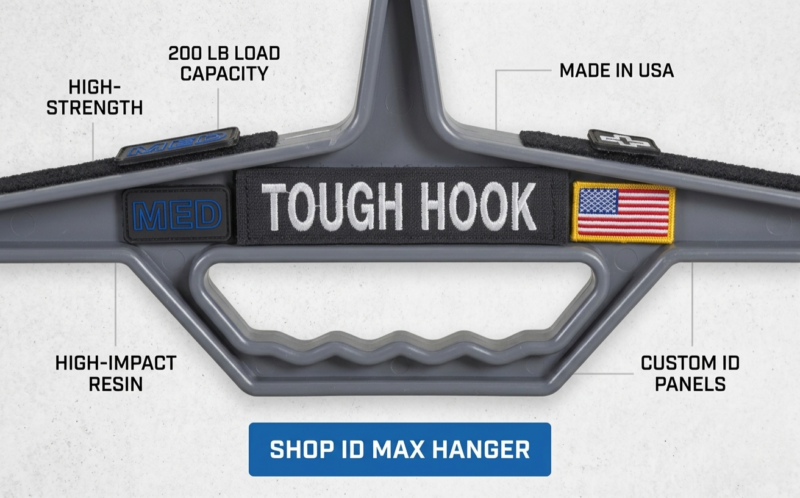
In shared storage environments, precincts, firehouses, barracks, or unit gear rooms, gear identification matters. The Original ID MAX Tactical Hanger features three 1″x5″ Velcro loop strips for attaching name strips or unit patches directly to the hanger. Same 200 lb rating. Same USA-made construction. Get the ID MAX Tactical Hanger here and know exactly whose gear is whose at a glance.
6. An Integrated Handle for Fast Gear Deployment
This feature is underrated until you need it. An integrated carry handle built into the hanger body lets you grab your entire gear setup, vest, armor, and hanger and move it instantly without disassembling anything.
For rapid response situations where seconds matter, being able to grab your fully loaded hanger and go is a meaningful operational advantage. As explored in When Seconds Matter: Grab-and-Go Storage for Tactical Rapid Response Units, the way gear is stored directly affects how fast it can be deployed, and a hanger with an integrated handle is one of the simplest ways to shave time off your response.
Conclusion
Tactical gear represents a significant investment in money, in time, and in the protection it provides. The hanger holding that gear between deployments should be treated with the same seriousness as the gear itself. A cheap plastic hanger under a loaded plate carrier is not just a storage problem. It is a slow degradation of the equipment you depend on. Wrong shape, wrong load rating, wrong construction, and your gear pays the price over weeks and months of improper storage.
Heavy-duty plastic hangers built for tactical loads solve this completely. The right load rating, the right arm width, the right construction, and your gear come off the hanger in exactly the same condition it went on. Every single time. Free standard shipping on orders over $29.95. Lifetime warranty on every hanger. Made in the USA.
Frequently Asked Questions
Q1. Can a regular plastic hanger hold a plate carrier or body armor?
No. Standard plastic hangers are rated for a few pounds at most and will crack, bend, or snap immediately under the weight of a plate carrier or body armor, which typically weighs 20–40 lbs. You need a hanger specifically rated for heavy tactical loads — a minimum of 150 lbs, ideally 200 lbs.
Q2. Does the type of hanger actually affect the condition of tactical gear over time?
Absolutely. Hanging a tactical vest or plate carrier on a narrow, low-capacity hanger creates pressure points that deform the shoulder structure and compress internal padding over time. A wide, load-rated hanger preserves the shape and structural integrity of gear between uses, which directly affects how it performs and fits when worn.
Q3. What makes heavy-duty plastic better than metal hangers for tactical gear?
High-quality impact-resistant plastic does not rust, corrode, or transfer marks onto fabric, all problems associated with metal hangers in humid or outdoor storage environments. Heavy-duty plastic rated for 150–200 lbs matches the structural performance of metal while being lighter, corrosion-proof, and gentler on gear materials.
Q4. How do I store tactical gear properly when it is not in use?
Hang it fully on a load-rated hanger with wide arms that support the vest’s or carrier’s full shoulder span. Keep it in a cool, dry location away from direct sunlight. Avoid folding, stacking, or leaving gear on the floor all of which create pressure points that degrade materials over time.
Q5. Are Tough Hook tactical hangers suitable for shared unit or precinct storage?
Yes. Tough Hook offers ID hanger variants with Velcro identification strips specifically designed for shared storage environments like firehouses, precincts, and unit gear rooms. These allow each piece of gear to be clearly labeled and identified without any additional accessories.