
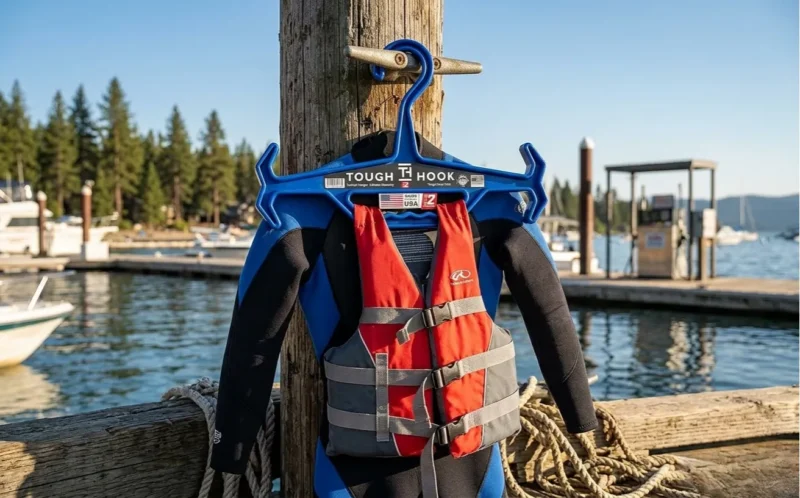
Most divers and paddlers spend serious money on wetsuits and life jackets, then hang them on whatever hook is nearest the door. Wire hangers stretch the neoprene shoulders out of shape. Narrow plastic hangers create pressure creases that weaken seams over time. A dedicated scuba gear hanger is built to avoid both problems, and choosing the right hanger for wetsuits and life vests is not a minor detail.
It directly affects how well the gear dries, how long the material holds its shape, and how ready the equipment is the next time you need it. The Tough Hanger XL is purpose-built for oversized and heavy gear, with an extra-wide shoulder span and a 200 lb rating that keeps saturated neoprene fully supported through every drying cycle.
What to Look for in a Wetsuit and Life Vest Hanger
Not every hanger marketed for marine gear is actually built for it. These six factors are what separate a hanger that protects your investment from one that quietly damages it over time.
Material Durability in Wet Environments
The first thing to evaluate is what the hanger is made from. Standard hangers corrode, rust, or warp when exposed to saltwater, humidity, and repeated wet loading. The right material for marine gear storage is either a non-corrosive polymer with UV resistance or a composite that holds its structure under sustained moisture.
High-impact polypropylene is particularly well-suited because it resists rust entirely, absorbs impact without cracking, and does not transfer corrosion onto zippers or hardware the way degrading metal can. What makes a plastic hanger worth using comes down to the grade of material, and that matters twice as much in a wet environment. It is also worth checking how a hanger handles salt exposure over repeated cycles, since dried salt residue left on a hanger’s surface accelerates wear on both the hanger and the gear hanging from it.
Wide Shoulder Design Prevents Distortion
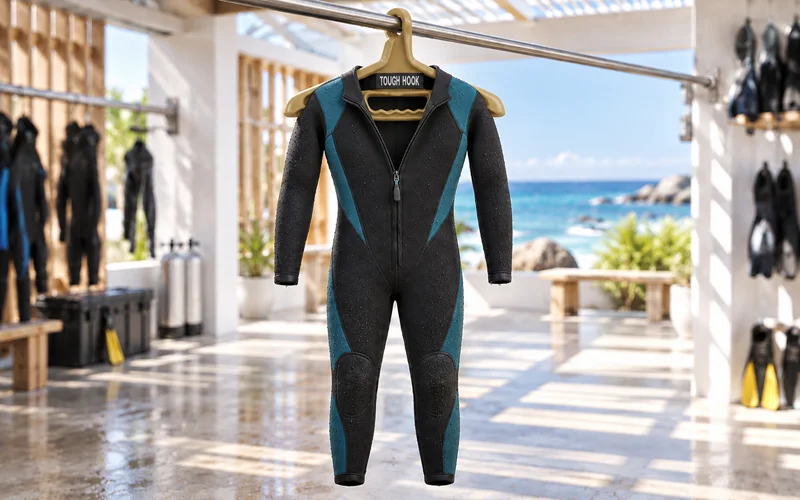
Shoulder width is the most critical dimension on any hanger used for wetsuits or life vests. A narrow shoulder concentrates the garment’s full weight over a small surface area, which stretches and distorts the material at the hang point over time. Wide shoulder contours distribute that weight evenly and keep the gear in its natural shape while drying.
This matters more for wetsuits than almost any other garment because neoprene retains deformation. Once the shoulder area stretches out of shape, it does not return to its original form. Building a consistent post-session hanging routine around a wide-shouldered hanger is one of the simplest ways to add years to a suit’s usable life.
Ventilation and Airflow Speed Up Drying
A hanger that traps moisture against the material defeats the purpose of hanging gear to dry. Open frame structures and ventilation openings allow air to move through the garment from multiple directions rather than just around the outside. This dramatically reduces drying time and, more importantly, prevents the interior moisture buildup that causes mildew and persistent odor in neoprene.
Life vests with foam inserts are especially prone to holding water in their core, and active airflow from a well-designed hanger is the most effective way to address that without damage. Hangers built for heavy gear drying incorporate ventilation into their structure rather than treating it as an afterthought, and the difference shows up quickly in how fast a suit stops smelling like standing water.
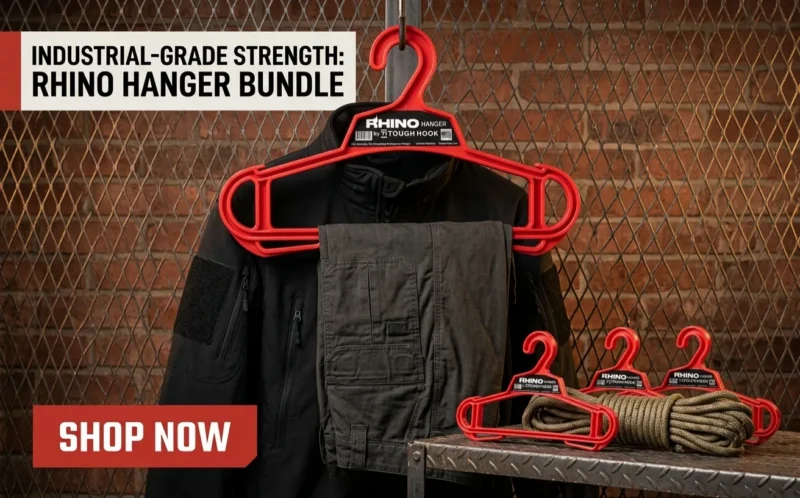
Skipping this step is usually why wet gear ends up deteriorating instead of drying properly between sessions. Hanging a full dive kit or multiple pieces at once requires a solution built for the load. The RHINO 4-Pack gives you the capacity to store an entire season of gear properly without compromise.
Weight Capacity for Saturated Gear
Wet wetsuits and saturated life vests are significantly heavier than their dry weight suggests. A wetsuit can weigh up to 15 pounds when fully saturated, while a waterlogged life vest adds another 10 to 12 pounds. When both are stored together, the combined load can exceed 25 pounds.
A hanger rated below that threshold will flex, warp, or fail under repeated loading. For further reference on life jacket care and storage standards, the US Coast Guard Boating Safety Division outlines best practices for maintaining the performance of flotation devices over time. Whether a standard hanger can hold heavy gear is a question worth asking before trusting your equipment to the wrong product.
Storage Between Sessions
Between sessions, wetsuits and life vests need to be stored somewhere that prevents UV exposure, maintains airflow, and avoids compression. A well-ventilated indoor space, such as a gear closet or utility room, is ideal for short-term storage. The hanger should keep the garment fully extended rather than allowing it to fold or bunch at any point.
Compression along seams creates stress fractures in neoprene over time and can compromise the stitching on life vest panels. How to organize heavy gear in a dedicated storage space applies directly to marine equipment as well, since the same principles of weight distribution and ventilation carry across gear types. Setting up a proper watersports gear station near the door also removes the temptation to leave wet gear balled up in a bag between trips.
Long Term and Off-Season Storage
If the gear is going into storage for a full season, a few additional steps are necessary beyond simply hanging it up. Both the wetsuit and life vest should be cleaned thoroughly before storage to remove salt, sunscreen residue, and organic matter that degrade the material over months.
Once dry, hang each piece on a wide-shouldered hanger in a cool, dry space away from direct sunlight and heat sources. Never fold neoprene for long-term storage, as fold lines can crack the material. Life vest foam also compresses permanently if stored under weight or in a folded position for extended periods. Choosing hardware built for genuine marine-grade durability from the start is the difference between gear that holds up and gear that quietly fails between seasons.
The Right Hanger Protects Gear That Protects You
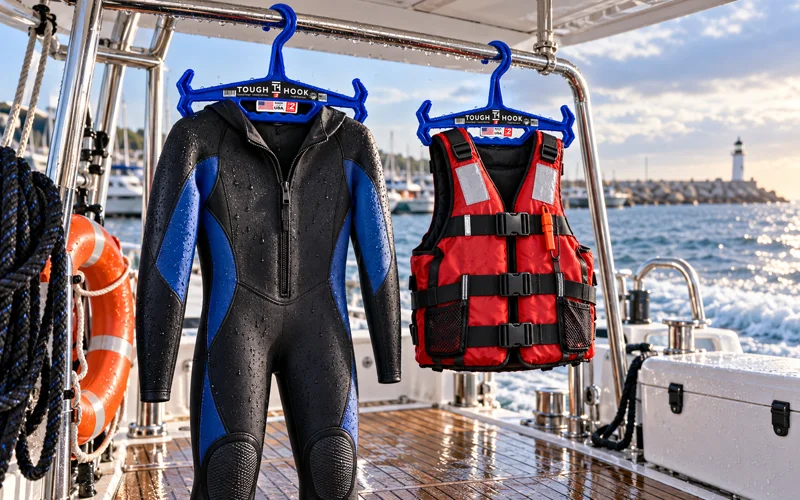
Wetsuits and life vests are safety equipment as much as they are performance gear. Storing them on hangers that stretch, rust, or fail under load introduces gradual damage that is easy to miss until the gear fails when it matters most. A wide-shouldered, high-capacity hanger made of non-corrosive material is a small investment compared to the cost of the gear it supports. Divers who take storage seriously tend to reach for the same hangers built specifically for scuba divers, because getting the foundation right from day one makes everything else in a marine gear storage routine simpler to maintain.
Frequently Asked Questions
These are the questions that come up most often when choosing a hanger for wetsuits and life vests.
What weight capacity should a wetsuit hanger have?
At a minimum, look for a hanger rated for 25 to 30 pounds to safely support a saturated wetsuit. If you are hanging a wetsuit and a life vest together, or storing heavier cold-water gear, a capacity of 50 pounds or more provides the safety margin needed to prevent deformation or failure under repeated loading.
Can I use the same hanger for both a wetsuit and a life vest?
Yes, as long as the hanger has a wide enough shoulder profile and sufficient weight capacity to support both at once. A hanger rated at 50 pounds or more with a wide-beam design handles the combined load without flexing or causing pressure damage to either garment.
Are plastic hangers better than metal for marine gear?
For marine environments, high-quality non-corrosive plastic or composite hangers generally outperform metal options. Marine-grade metals can hold up reasonably well, but standard steel corrodes under saltwater exposure and can transfer rust to zippers and hardware. UV resistant polypropylene avoids these issues entirely and holds its rated capacity without degrading in humid conditions.
How do I prevent mildew on a wetsuit during storage?
Thorough drying before storage is the primary defense against mildew. Hang the wetsuit inside out first to dry the interior lining completely, then flip it to finish the outside. Store in a well-ventilated space rather than in a sealed bag or airtight container, and apply a light dusting of talc to control interior moisture during extended storage.
How often should I replace my wetsuit hanger?
A quality hanger made from high-impact polypropylene or a rust-proof composite should last many years under normal use. Replace it once you notice visible warping, cracking at the hook or shoulder points, or any reduction in structural rigidity that causes the hanger to flex noticeably under load.