
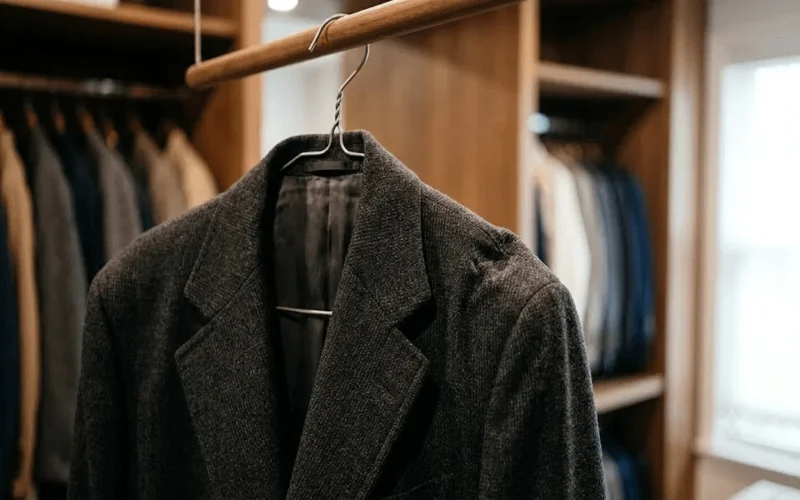
Pull an expensive wool coat off a thin hanger after a season in storage and there is a decent chance you will find two small bumps rising through the fabric at the shoulder, right where the hanger’s hooks pressed against the inside of the garment. The coat still fits and still looks fine from a distance, but that faint ridge is the first visible sign of a problem that builds slowly and rarely gets noticed until it has already set in.
This is the shoulder indent problem, and it affects far more than wool coats. Leather jackets, motorcycle gear, tailored uniforms, and other structured outerwear are all vulnerable to the same issue, since they all share broad, shaped shoulders that a narrow or poorly contoured hanger was never built to support. This guide explains what causes shoulder indents, which garments are most at risk, and what actually prevents the damage before it happens.
Coats and structured jackets need a shoulder that matches their own shape. The Original Tough Hook Hanger features a wide, contoured profile designed to support heavier outerwear rather than concentrating pressure at a single point.

What Shoulder Indents Actually Are
A shoulder indent is a small permanent or semi-permanent deformation in a garment’s fabric, usually located exactly where a hanger’s hook or narrow tip has pressed against the inside of the shoulder over time. Instead of the shoulder forming a single smooth curve, the fabric develops a visible dip, ridge, or bump at that point.
The mechanism behind it is straightforward. A hanger touches a garment at only a few small points rather than supporting its full width. Every bit of the garment’s weight funnels down through those points instead of spreading across the shoulder seam, and fabric under sustained, concentrated pressure eventually takes on that shape.
How Narrow or Poorly Shaped Hangers Create Pressure Points
Wire hangers are the most obvious offender, since their hook and shoulders are essentially the same thin piece of metal bent into shape. Basic plastic hangers are only marginally better if their shoulder profile is narrow or sharply angled rather than broad and rounded. Even some wooden hangers create pressure points if their shoulder shape does not roughly match the garment’s own cut.
The University of Kentucky Cooperative Extension’s guidance on clothing storage notes directly that hanger support should be matched to the garment so that stress is not concentrated in a way that causes distortion. That principle applies just as much to a leather motorcycle jacket as it does to a wool overcoat, even though the two garments respond to that stress differently.
Why Weight, Moisture, Fabric, and Time All Make It Worse
Garment Weight
Heavier garments put more pressure through fewer contact points, which speeds up the rate at which an indent becomes visible. A lightweight blazer on a narrow hanger might show no signs of stress for years, while a heavy wool overcoat on the same hanger can develop a visible mark within a single season.
Moisture and Humidity
Damp conditions make most fibers more pliable and more prone to holding a new shape. A garage or mudroom with fluctuating humidity accelerates the process compared to a stable, climate-controlled closet.
Fabric Type
Wool, leather, and heavily structured fabrics tend to hold a pressed-in shape more readily than lighter, more elastic materials. This is part of why leather jackets in particular develop visible shoulder marks faster than a cotton shirt ever would.
Padding and Interior Structure
Garments with shoulder pads or interior structure, such as tailored coats and many uniforms, distribute weight differently than unstructured pieces. Padding can either help by spreading pressure across a wider area or hurt by creating a stiffer point that resists a narrow hanger even more forcefully.
Storage Duration
Time is the single biggest multiplier. A coat hung improperly for a weekend is unlikely to show any damage. The same coat hung the same way for an entire off-season is a very different situation.
Which Garments Are Most Vulnerable
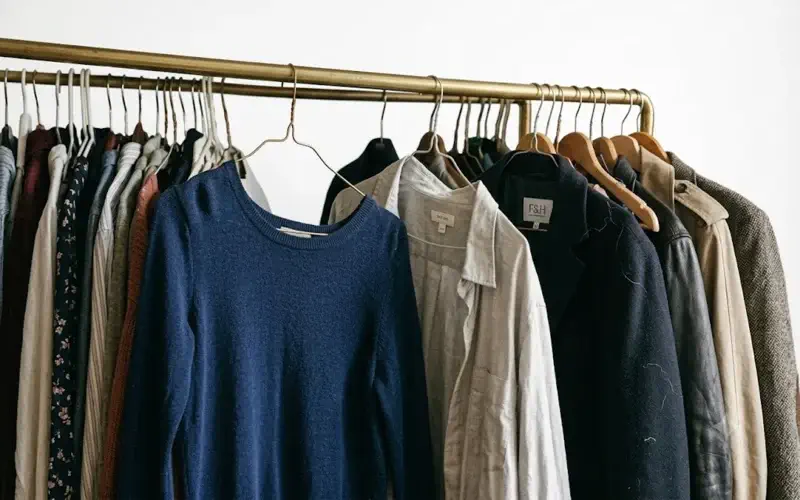
Wool and structured overcoats are especially prone to shoulder indents because of their weight and their tailored, padded shoulder construction. Proper storage of coats generally starts with matching the hanger’s shoulder width to the coat’s own cut rather than reaching for whatever hanger is already on the rod.
Leather jackets are vulnerable for a different reason. Leather holds a pressed shape more readily than woven fabric, so choosing the right hanger for heavy motorcycle jackets matters as much for shape preservation as it does for basic support.
Uniforms present their own version of the problem, since they are often handled daily and need to look sharp on short notice. Storage habits that keep military uniforms looking sharp tend to rely on consistent, properly sized hangers rather than whatever happens to be available in a shared locker.
Signs a Hanger Is Already Damaging a Garment
A visible bump, dip, or ridge at the shoulder seam is the clearest sign, but it is not the only one. Fabric that feels stiffer or thinner at a specific spot near the shoulder can indicate repeated pressure. A garment that no longer sits evenly on a flat surface, showing a slight peak where the hanger sat, is often past the early warning stage. Shiny or slightly discolored patches on leather at the same location are a leather-specific version of the same underlying issue.
What Actually Prevents Shoulder Indents
Hanger Width
A hanger’s shoulder should be close to the garment’s shoulder seam width. Too narrow a concentration puts pressure at the tips. Too wide can distort the garment in the opposite direction, so matching width matters more than simply choosing the widest hanger available.
Shoulder Contour
A rounded, gently curved shoulder distributes weight across a broader surface than a flat or sharply angled one. This is part of why uniform integrity issues involving fabric stress and deformation so often trace back to hanger shape rather than the fabric itself.
Surface Shape and Texture
A smooth surface without sharp edges or seams reduces the chance of a hanger leaving a visible mark, particularly on leather or other surface-sensitive materials. Rough or textured hanger surfaces can transfer their own texture onto delicate fabric over time.
Overall Strength
A hanger that flexes or bends under a coat’s weight changes shape while the garment is hanging, which defeats the purpose of a well-contoured shoulder in the first place. Consistent, reliable support depends on the hanger holding its shape under load, not just having the right profile when empty. This aligns with long-standing guidance from the National Park Service on hanging garment storage, which identifies shoulder and neck stress as the primary source of distortion in any garment left hanging for an extended period.
Is the Damage Reversible?
In many cases, yes, especially if it is caught early. Light indentation in wool and similar woven fabrics often relaxes on its own after proper hanging or light steaming. Deeper or long-standing creases and marks on leather in particular, are less predictable and may not fully release. This is a fair and important distinction, since not every hanger mistake results in permanent damage. The safest approach is to treat early signs as a reason to switch hangers immediately rather than waiting to see how bad it gets.
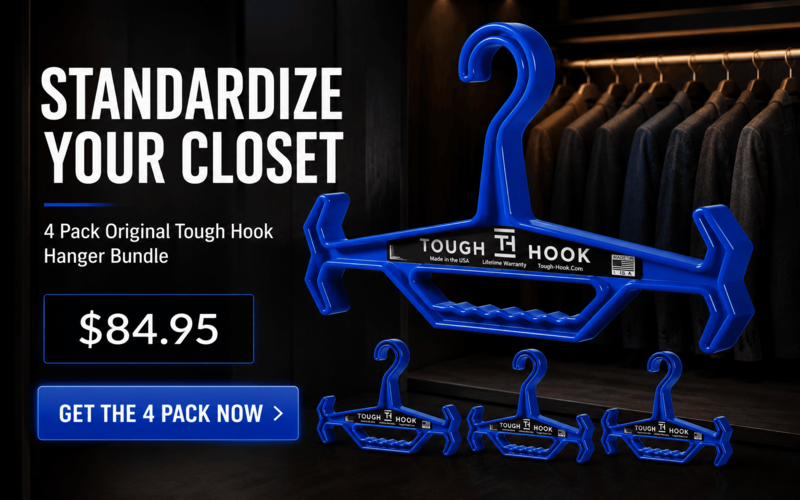
Households managing several coats or structured jackets often find it easier to standardize on a single hanger type throughout the closet. The 4 Pack Original Tough Hook Hanger Bundle makes it simple to set up that consistency.
How to Store Heavy Coats Correctly
Start by matching the hanger’s shoulder width to the coat itself, then confirm the hanger holds its shape under the coat’s actual weight rather than flexing or bending. Give coats enough space on the rod so they are not compressed against neighboring garments, which adds its own kind of pressure on top of whatever the hanger is already doing. For coats stored long term, periodically checking the shoulder area for early signs of pressure marks makes it easier to catch a problem before it becomes permanent. Sustainable storage choices that make hangers last for years tend to follow the same pattern: matching the hanger to the garment from the start, rather than repeatedly replacing damaged coats or hangers.
Common Mistakes People Make With Coat Storage
Reaching for the nearest available hanger regardless of shoulder width is the most common mistake, especially in shared or crowded closets. Leaving heavy coats on wire hangers left over from the dry cleaner is another frequent one, since those hangers are among the narrowest and least supportive available. Crowding a closet rod so tightly that coats press against each other adds pressure beyond what the hanger alone can handle. Ignoring early signs of a shoulder mark, rather than switching hangers as soon as one appears, is what turns a minor issue into a lasting one.
Shoulder Indent Prevention Checklist
- Match the hanger’s shoulder width to the coat or jacket being hung
- Confirm the hanger holds its shape under the garment’s actual weight
- Avoid wire and other narrow, unpadded hangers for heavy outerwear
- Leave enough rod space to prevent compression between garments
- Check the shoulder areas periodically during long-term storage
- Switch hangers immediately at the first sign of a pressure mark
Protecting the Coats and Jackets Worth Keeping
Shoulder indents are not inevitable, and they are not usually the result of one bad day on the wrong hanger. They build gradually from a mismatch between a garment’s actual shoulder shape and weight and the hanger tasked with supporting it, and that mismatch is entirely preventable with the right hardware.
For coats, leather jackets, uniforms, and other structured outerwear that are worth protecting, a wide, contoured, sufficiently strong hanger solves the problem at its source rather than treating the damage after it appears. Tough Hook builds its heavy-duty hangers around exactly that kind of support, giving expensive garments a shoulder shape that actually matches their own.
Frequently Asked Questions
What causes shoulder indents on coats and jackets?
Shoulder indents occur when a hanger’s hook or narrow tip concentrates a garment’s weight at a small point rather than spreading it across the full shoulder width. Over time, sustained pressure at that point causes the fabric to hold a slight dip or ridge, particularly in heavier or more structured garments.
Can any hanger permanently damage a coat?
Not necessarily. Most shoulder marks develop gradually and depend heavily on the garment’s weight, fabric type, and how long it stays on the same hanger. A single season on the wrong hanger will not always cause permanent damage, but repeated or prolonged use of a poorly shaped hanger considerably increases the risk.
Are leather jackets more prone to shoulder indents than fabric coats?
Generally, yes. Leather holds a pressed shape more readily than woven fabric, so pressure points from a narrow hanger tend to appear sooner and can be harder to fully reverse. A wide, smooth, well-supported hanger matters more for leather than for most other garment types.
Can shoulder indents be fixed once they appear?
Light indentation often improves with proper hanging on a correctly sized hanger, sometimes helped along with gentle steaming. Deeper creases or long-standing marks, especially on leather, are less predictable and may not fully release. Catching the issue early gives the best chance of a full recovery.
How wide should a hanger be for a heavy coat?
The hanger’s shoulder width should closely match the coat’s own shoulder seam. A hanger that is too narrow concentrates pressure at the tips, while one that is significantly too wide can distort the garment in a different way. There is no single universal width, since it depends on the specific coat.
Do uniforms develop shoulder indents the same way coats do?
Yes, particularly uniforms with structured shoulders or interior padding that are hung daily. Because uniforms are handled so frequently, consistent use of a properly sized, sturdy hanger matters even more than it does for a coat worn only occasionally.