

A full EOD suit assembly weighs approximately 45 kilograms. The jacket and trousers account for around 35 kg of that total, with the helmet adding another 10 kg. Individually, each component is heavier than most residential hangers are rated for at all. Together, the full ensemble exceeds the structural limits of every standard hanger type, including wire, wood, and thin-wall plastic.
For EOD units and bomb disposal teams, this is not an abstract concern. A hanger that fails under the sustained weight of a bomb suit is a safety, maintenance, and equipment integrity issue simultaneously. Understanding what makes a hanger genuinely capable of supporting EOD gear and what causes standard options to fail is the starting point for getting storage right.
Rated to 200 lbs. Built for Exactly This
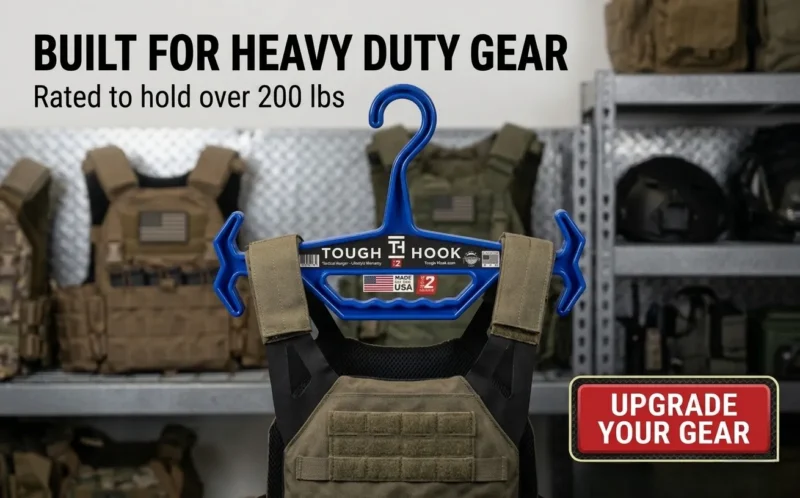
The Original Tough Hook Tactical Hanger is engineered from impact-resistant polypropylene with patented I-beam construction designed to hold over 200 lbs of tactical gear without deforming, bending, or shifting load to a single point.
Six Factors That Determine Whether a Hanger Can Hold EOD Gear
EOD suits are not oversized clothing they are multi-component protective systems with variable weight distribution, irregular structure, and exacting storage requirements. A hanger capable of reliably supporting one needs to meet specific criteria across material, capacity, design, and installation. Here is how each factor plays out in practice.
1. Material Strength Sets the Performance Ceiling
The material a hanger is constructed from determines how much sustained load it can hold before it begins to deform, crack, or shift. For EOD gear, this threshold matters more than for almost any other application. The suit will typically remain on the hanger for extended periods between deployments, and cumulative load stress is a real failure mode.
Engineering-grade polypropylene is one of the strongest materials available in heavy-duty hanger construction. It combines impact resistance with flexibility, meaning it absorbs stress without cracking rather than becoming brittle over time.
Reinforced metals offer similar load-bearing capacity but introduce corrosion risk in damp environments such as gear bays and equipment rooms. For EOD storage, impact-resistant polymer construction rated explicitly for high sustained loads is the most reliable material choice across varied environmental conditions.
2. Rated Load Capacity Must Exceed the Suit’s Full Weight
A hanger’s stated weight rating must be treated as a ceiling, not a target. For EOD suits, the practical minimum static load capacity is 150 lbs, equivalent to roughly double the suit’s total weight. That margin exists to account for dynamic load events: the brief spike in force when a suit is placed on or lifted off a hanger, uneven weight distribution from asymmetric components, and long-term structural fatigue from continuous loading.
Hangers rated only to the suit’s exact weight offer no safety buffer. Over time, repeated load cycling hanging, removing, and rehinging causes progressive deflection in undersized hardware. Best practice, consistent with heavy-duty tactical gear storage standards, is to use hangers rated to at least 200 lbs for any full EOD ensemble storage application.
3. Standard Hanger Types All Fail Under EOD Suit Weight
Understanding why standard options fail helps clarify what is actually required. Wooden hangers, even hardwood varieties like beech or oak, lack the structural consistency to support a sustained load of 100 lbs. They are vulnerable to moisture, which weakens the grain over time, and their single-rail design concentrates stress at the centre point rather than distributing it across the full arm span.
Plastic hangers, including thick-walled polypropylene retail variants, were not engineered for sustained heavy loads. Testing confirms that standard plastic hangers begin to deform under loads above approximately 5 kg, making them structurally inappropriate for EOD gear at any weight.
Metal wire hangers present a different failure mode: their narrow gauge concentrates load into a very small contact area, creating pressure points that damage harness straps and cause the hanger itself to bend permanently. None of these types is suitable, not even as a temporary solution.
EOD Gear Rooms Require Identification, Not Just Storage
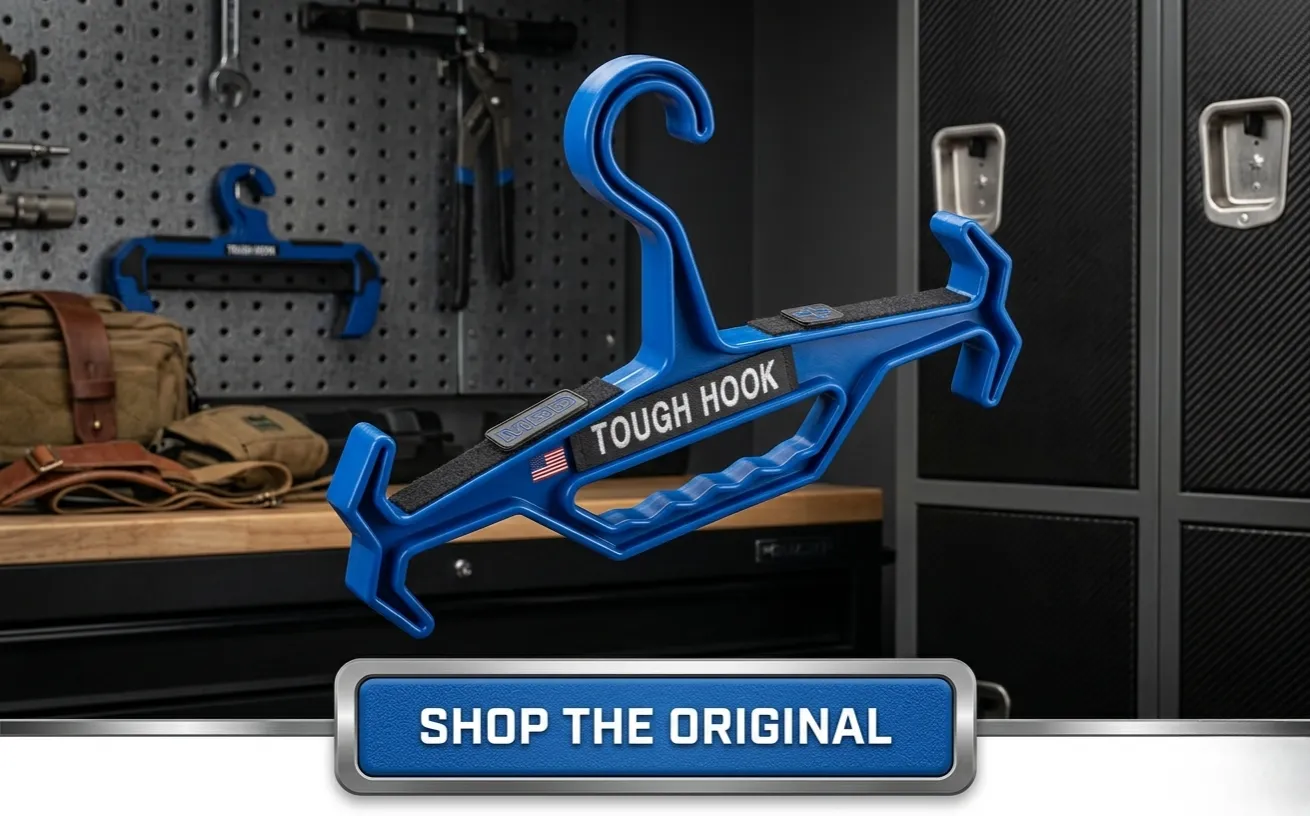
When multiple operators share a storage space, the Original ID MAX Tactical Hanger adds three Velcro ID strip loops to the same 200 lb-rated frame, letting every operator label and locate their gear instantly. USA-made, lifetime warranty.
4. Weight Distribution Design Protects Both Hanger and Suit
Load capacity rating and actual performance under an irregularly shaped EOD suit are two different things. A hanger rated for 200 lbs, which concentrates the load at a single contact point, will damage harness straps, compress shoulder padding, and eventually fail at the stress-concentration zone, even if the overall rating is sufficient on paper.
Effective EOD gear hangers use wide arm spans, multi-point contact surfaces, and reinforced hook geometry to distribute load evenly across the suit’s shoulder and harness structure. Multi-hook configurations allow the helmet, jacket, and trouser components to hang independently, reducing the total load on any single contact point and preventing interaction between components that can cause creasing or hardware wear. Symmetrical end-hooks prevent the suit from shifting or slipping during storage, which is particularly important in high-traffic gear rooms where hangers are regularly accessed. These design principles are detailed in Tough Hook’s broader guidance on creating a dedicated tactical gear storage space.
5. Ventilation and Corrosion Resistance Matter for Long-Term Storage
EOD suits are regularly exposed to field conditions before returning to storage. Moisture trapped inside the suit’s layers from sweat, precipitation, or decontamination procedures accelerates material degradation if the storage system does not allow it to escape. Open-grid or perforated hanger designs promote airflow across the suit during storage, significantly improving drying time and reducing the risk of mold or material breakdown in the inner layers.
The hanger itself must also resist the damp environments common to gear rooms and apparatus bays. Polymer construction is inherently corrosion-resistant, which gives it a meaningful long-term advantage over metal alternatives in high-humidity storage environments. Powder-coated metal hangers offer some corrosion resistance but remain vulnerable if the coating is scratched or chipped during regular use.
6. Proper Installation Ensures the Entire System Performs
A heavy-duty hanger installed on inadequate wall anchoring fails the same way an undersized hanger fails; the failure just happens at a different point in the system. For EOD suit storage, hangers must be mounted to reinforced wall structures capable of bearing sustained loads well above the suit’s weight. Standard drywall anchors are not appropriate. Use structural studs, reinforced backing plates, or purpose-built gear rack systems rated for the combined load.
Hook height should position the suit clear of the floor with adequate clearance for the helmet and trouser legs to hang without contact. Where multiple suits are stored in the same space, spacing between hangers should prevent any lateral contact between components during storage or retrieval. A well-installed system is also easier to use under time pressure; the first-responder gear-hanger principles that prioritise rapid access apply directly to EOD gear-room design.
The Right Hanger Is the First Line of Equipment Protection
An EOD suit represents thousands of dollars in protective technology and is critical to the operator’s safety. Leaving it on an undersized hanger is not a minor oversight it is a storage failure that accumulates damage with every use cycle. The six factors above define what a capable hanger requires: the right material, a rated load capacity above 150 lbs, intelligent weight-distribution design, ventilation for long-term storage, corrosion resistance, and a properly reinforced installation. Evaluate your current setup against each one. If any factor falls short, the storage system needs to be upgraded before the suit does.
Frequently Asked Questions
What materials are EOD suits typically made from?
EOD suits are constructed from multiple protective layers, typically including Kevlar, aramid fibers, and high-density polyethylene. The outer shell is designed for fragmentation resistance, while interior layers provide blast attenuation and mobility. The helmet incorporates dense ballistic materials in the visor and crown, which concentrate weight in specific areas and require adequate support from storage hardware.
How should EOD suits be stored to prevent deformation?
EOD suits should be hung vertically by their shoulder straps or harness loops on a hanger rated for the full ensemble weight. Avoid folding, crumpling, or storing flat. The helmet and detachable components should be stored separately on padded surfaces or dedicated shelving. A stable, climate-controlled environment with consistent humidity prevents material stiffening and padding compression over extended storage periods.
What is the minimum static load capacity for EOD suit hangers?
The practical minimum static load capacity is 150 lbs, providing a roughly 50% safety margin over the full suit’s weight. This margin accounts for dynamic load spikes during gear retrieval, uneven weight distribution from asymmetric suit components, and long-term structural fatigue from repeated load cycling. Hangers rated at 200 lbs provide additional headroom and are the recommended standard for full EOD ensemble storage.
What type of hangers are recommended for EOD suits?
Heavy-duty tactical hangers constructed from engineering-grade, impact-resistant polypropylene with patented I-beam construction are the most suitable option. They combine the necessary load capacity with corrosion resistance, wide weight-distributing arm spans, and integrated carry handles, making gear retrieval and transport more practical in high-pressure environments.
How are EOD suit hangers installed for optimal support?
Hangers should be mounted to structural studs or reinforced backing plates, never standard drywall anchors. The height should be set so that the full suit, including the helmet and trouser legs, hangs clear of the floor. In shared gear rooms, hangers should be spaced to prevent lateral contact between suits during storage and retrieval. The overall mounting system should be rated to handle the combined load of the suit and any dynamic forces applied during gear donning.