
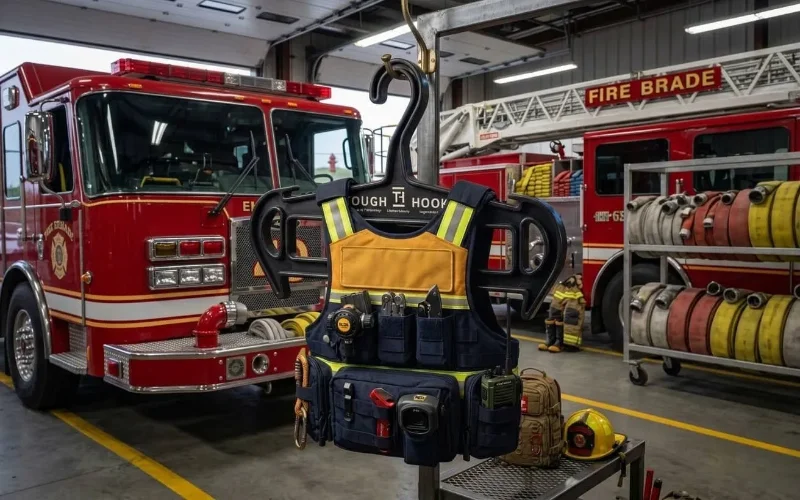
Firefighter turnout gear isn’t light. A full set of coat, pants, boots, helmet, and gloves can weigh anywhere from 30 to 50 pounds dry, and significantly more after a call. That weight, combined with the need for proper ventilation between uses, means the hanger you choose matters more than most firefighters initially expect.
The wrong hanger bends, breaks seams, creates pressure points in the shoulder padding, and slows the drying process, which is critical to keeping PPE safe and ready. The right one does the opposite: supports the full load, promotes airflow, and keeps gear in the shape it was built to protect you in.
This guide breaks down exactly what to look for and which Tough Hook options are built for the job.
Why Standard Hangers Fail Firefighter Gear
Most commercial hangers are rated for clothing that weighs a few pounds at most. Turnout gear is an entirely different category. Water-soaked bunker coats alone can weigh more than 20 pounds. Add a helmet, gloves, and boots, and you’re asking a standard wire or plastic hanger to hold a load it was never engineered for. Whether your department calls it turnout gear or bunker gear, the equipment and the storage problem are exactly the same.
The result is predictable: bent frames, collapsed shoulders, gear pooling at the bottom of a locker, and moisture trapped in folds that can’t ventilate. Over time, this contributes to fabric stress, seal degradation, and wear, shortening the service life of expensive PPE.
If you’ve recently read about properly drying bunker gear after a call, you already know that airflow during the drying phase is critical. The hanger you use directly affects whether that airflow occurs or is blocked.
Tough Hook hangers are engineered specifically for heavy tactical and protective gear. Rated up to 200 lbs, built with military-grade materials, and proudly made in the USA. Shop the Original Tough Hook Tactical Hanger

How Much Does Firefighter Turnout Gear Actually Weigh?
The short answer is more than most people expect. A basic set of turnout gear, also called bunker gear, made up of the coat, pants, boots, helmet, and gloves typically falls in the 30 to 50 pound range when dry, and a full loadout with SCBA and hand tools commonly reaches 60 to 80 pounds. Here’s roughly where that weight comes from:
- Turnout coat: around 8 to 10 lbs
- Turnout pants: around 12 to 15 lbs
- Boots (pair): around 8 to 10 lbs
- Helmet: around 3 to 4 lbs
- Gloves and hood: around 1 to 2 lbs
- SCBA (air pack): around 20 to 30 lbs
None of that accounts for water weight. A soaked turnout coat alone can add several pounds, which is exactly why a hanger built for a lightweight dress shirt has no place in a gear room, and why a dedicated bunker gear hanger with a real load rating matters more than size alone.
What Makes a Hanger Right for Turnout Gear
Load Capacity: Start Here
Weight capacity is the first filter. Turnout gear is heavy at rest and heavier after a call. Any hanger you rely on for firefighter PPE should be rated for at least 150 lbs ideally 200 lbs or more to handle gear that’s been soaked, packed with equipment, or stored with accessories attached.
Tough Hook’s lineup is built around this requirement from the ground up. The Tough Hanger XL supports up to 200 lbs using an I-beam structural design that distributes load across the full width of the hanger rather than concentrating stress at a single point. This prevents the sagging and deformation that destroys the shoulder structure of turnout coats over time.
For departments that need a hanger equally suited to coats, pants, harnesses, and tactical loadouts, the Original Tough Hook Tactical Hanger covers the same weight range and adds a reversible carry handle converting from hanger to transport grip without removing gear from the hook.
I-Beam Construction: Why It Matters
The I-beam design isn’t a marketing detail; it’s structural engineering applied to a hanger. The shape distributes load the same way an I-beam distributes stress in construction: by resisting flex at the points that matter. Under the sustained weight of wet turnout gear, a flat or hollow hanger bends. An I-beam hanger doesn’t.
Tough Hook hangers are manufactured from advanced high-impact polypropylene a material that resists warping under heat, cracking in cold, and degradation from chemical exposure common in fire stations. This matters in environments where gear is regularly cleaned with industrial detergents and stored in humid lockers.
The Carry Handle: A Detail That Changes Operations
One feature that often gets underestimated is the integrated reversible carry handle on Tough Hook hangers. When you’re pulling gear from a locker in gloves or transporting a full set of turnout equipment across a bay, a carry handle that accommodates gloved hands and supports 200 lbs of shifting weight is a genuine operational advantage.
This design came directly from a former US Army Sergeant who understood the gap between how professional-grade gear gets moved and what standard hangers were built to handle. The result is a hanger that works as a transport tool, not just a storage device.
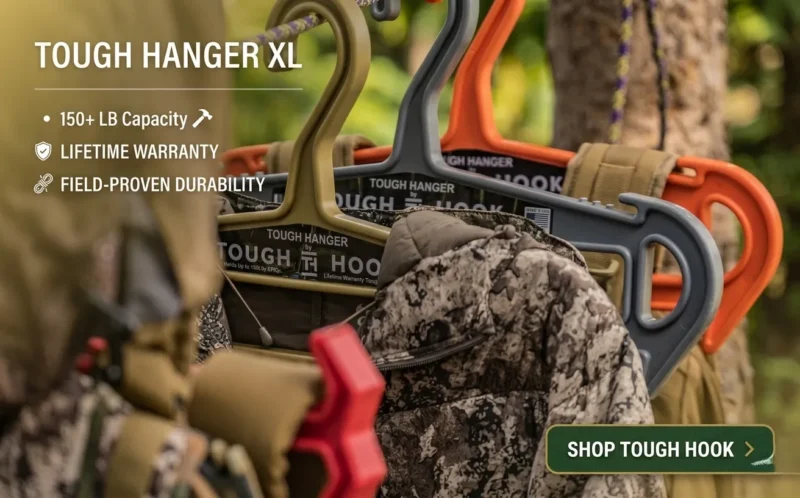
The Tough Hanger XL handles up to 200 lbs and is purpose-built for the heaviest protective gear. Wide shoulders, I-beam construction, integrated carry handle, everything a firefighter needs in one piece of equipment.
Material Durability: Built for Fire Station Conditions
Fire stations are hard on equipment. Humidity from wet gear, temperature swings between heated bays and cold outdoor air, exposure to cleaning chemicals, and the physical impact of daily operational use all take a toll on anything not built to withstand them.
Tough Hook hangers are manufactured from high-impact polypropylene, which is non-corrosive, non-metallic, and resistant to the conditions found in working fire stations. There’s no rust, no oxidation, and no coating that chips or degrades from chemical contact. The material maintains structural integrity across temperature extremes it won’t become brittle in cold storage or warp in a gear-drying area.
For departments operating in coastal or high-humidity environments where metal hardware corrodes quickly, this non-metallic construction is a meaningful advantage over steel or aluminum alternatives.
Versatility Across Emergency Services
Firefighter turnout gear is the most demanding application, but Tough Hook hangers are built to handle the full range of emergency services equipment. EMTs use them for medical bags and response kits. Law enforcement departments store tactical gear and body armor. Search and rescue teams hang rope systems, harnesses, and immersion suits. Station staff also use the same hanger for a duty uniform, so gear rooms don’t need a separate product just for everyday clothing.
The hooked ends accommodate standard racks, locker bars, gear room doors, and custom-mounted systems. Adjustable shoulder positions and strong clips with rubber-grip jaws handle irregular equipment shapes without slipping. This versatility makes Tough Hook a single investment that meets an entire department’s gear storage needs, rather than requiring different solutions for different equipment types.
For a broader look at how heavy-duty hangers perform across tactical and protective applications, this breakdown of heavy-duty plastic hangers for tactical gear covers the performance differences worth knowing before committing to a system.
Warranty and USA Manufacturing
Every Tough Hook hanger comes with a 100% Lifetime Limited Warranty. If a hanger breaks or fails under normal use, it’s replaced at no cost. For departments that purchase in volume and rely on equipment longevity, this eliminates the replacement-cost cycle associated with lower-quality alternatives.
Manufacturing in the USA also means quality control is consistent and supply chain delays don’t affect restocking for departments that need to maintain gear room capacity. The hanger itself also needs no real maintenance beyond an occasional wipe-down, one more durable, dependable piece of equipment the gear room doesn’t have to think about.
Where to Install Your Turnout Gear Hanger: Racks, Lockers, and Wall-Mounted Systems
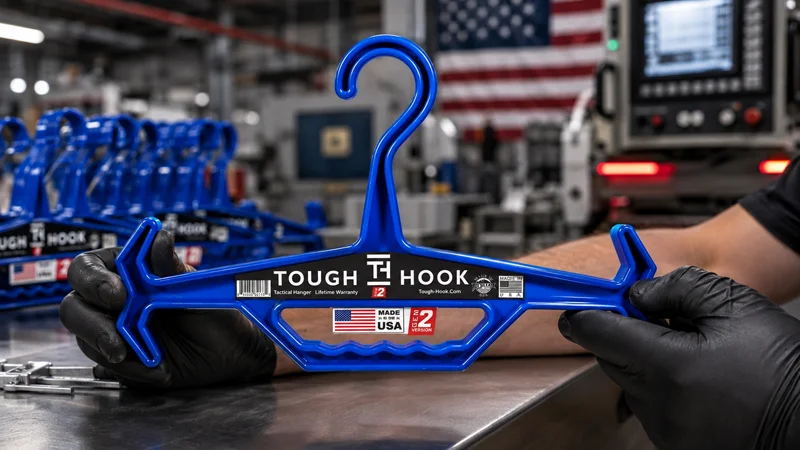
A hanger rated for 200 lbs still needs the right mounting point to do its job well. Most fire stations use one of three setups, and Tough Hook bunker gear hangers are built to work with all of them.
Rack bars in a shared gear room. Open rack systems are the standard in most stations, letting multiple sets of turnout gear hang side by side with enough space between them for airflow. The hooked ends on a Tough Hook hanger are sized to fit standard rack bar diameters, so gear slides on and off without wrestling a stuck hook.
Individual locker doors. For departments that assign lockers by person rather than by shift, a hanger that hooks directly onto a locker door or bar keeps gear, and a uniform if one is stored in the same locker, off the floor without needing extra hardware.
Wall-mounted hooks in the apparatus bay. Some departments mount single hooks directly on the apparatus bay wall near the truck, so gear is within reach the moment a call comes in. Because Tough Hook hangers work equally well on a fixed wall hook as they do on a rack bar, the same hanger adds real utility in the apparatus bay without requiring a different product for the gear room.
Whichever setup a department uses, the goal is the same: keep gear supported, ventilated, and easy to grab, without turning gear room management into a bigger job than it needs to be. A hanger that works across all three locations also adds real efficiency and convenience over a full duty cycle, without requiring a different setup for each spot in the station.
Choosing the Right Tough Hook for Your Department
Not every gear room or application needs the same hanger. Here’s how the lineup breaks down:
| Hanger | Capacity | Best for | Key feature |
|---|---|---|---|
| Tough Hanger XL | 200 lbs | The heaviest turnout gear configurations, including coats with full thermal liner, water-soaked after a call | Wide shoulder strap, carry handle included |
| Original Tough Hook Tactical Hanger | 200 lbs | Departments that need a single hanger for both storage and transport | Reversible carry handle accommodates gloved hands; supports a range of gear types beyond turnout coats |
| RHINO Hanger | 200 lbs | High-volume gear rooms where multiple sets need to be stored efficiently | Profile suited to rack-based storage systems |
| Original ID MAX Tactical Hanger | 200 lbs | Departments that need fast, accurate gear retrieval in low-light or high-pressure conditions | Designed with ID visibility in mind for individual identification and organization |
If you’re still working through which specs to prioritize, 7 Things to Know Before Buying Heavy-Duty Hangers covers the evaluation criteria to consider before a departmental purchase.
The Hanger That Keeps Up With the Gear

Turnout gear is one of the most expensive and safety-critical pieces of equipment in a fire station. Everything that affects how it’s stored, dried, and accessed between calls affects how it performs when it’s needed. A hanger rated for the load, built from materials that last in station conditions, and designed with operational realities in mind, isn’t a minor purchase; it’s part of maintaining the gear that keeps firefighters protected. Tough Hook was designed by someone who understood that gap, and the product reflects it.
Frequently Asked Questions
How much weight can Tough Hook hangers actually support?
The Tough Hanger XL and Original Tough Hook Tactical Hanger are rated for up to 200 lbs. This covers the full weight of water-soaked turnout gear, including coat, pants, and accessories, without any deformation of the hanger structure.
Can Tough Hook hangers be customized with department markings?
Yes. Tough Hook offers 100% white-label customization, including department logos, colors, and identification markings. Minimum order requirements apply. Contact the team directly for department pricing and specifications.
Do these hangers work on standard fire station gear racks?
Yes. The hooked ends are designed to fit standard rack bars, locker systems, and gear room doors. The design accommodates most configurations used in fire stations, training facilities, and emergency service locker rooms.
Does Tough Hook offer a warranty on their hangers?
Every Tough Hook hanger comes with a 100% Lifetime Limited Warranty covering manufacturing defects and structural failures. Replacements are sent at no cost, no purchase required.
Are Tough Hook hangers suitable for gear other than firefighter turnout coats?
Yes. The same hangers are used across firefighting, law enforcement, EMS, military, and search-and-rescue applications. The load capacity and design accommodate body armor, tactical bags, medical kits, harnesses, and immersion suits, among other equipment.