Not all scuba diving tanks are the same
When you’re looking for the best scuba tank, there are a few things you can look at in order to compare one tank to another. Depending on your experience level and how long you’re planning to be in the water, the tank you choose can be small or large. Since there are a lot of different scuba diving tanks to choose from, finding the right one should never be a problem once you know what to compare.
Tanks for scuba diving can vary, but here are a few things you should look for when choosing the right one:
- The water capacity, which is measured in cubic feet and typically ranges from around 15 cubic feet for small pony bottles up to roughly 120 cubic feet for large steel cylinders.
- The weight of the tank. Tanks that weigh more than 35 pounds usually require special equipment when you’re ready to store them for next time, such as a heavy-duty hanger.
- The PSI, or pounds per square inch, rating. Look at the number itself, and also check that the tank has a current hydrostatic test and visual inspection stamp.
If you’re still assembling the rest of your kit, our scuba diving equipment checklist and beginner’s guide to scuba gear walk through everything else you’ll want before your first dive.
Scuba tank weight, capacity, and PSI at a glance
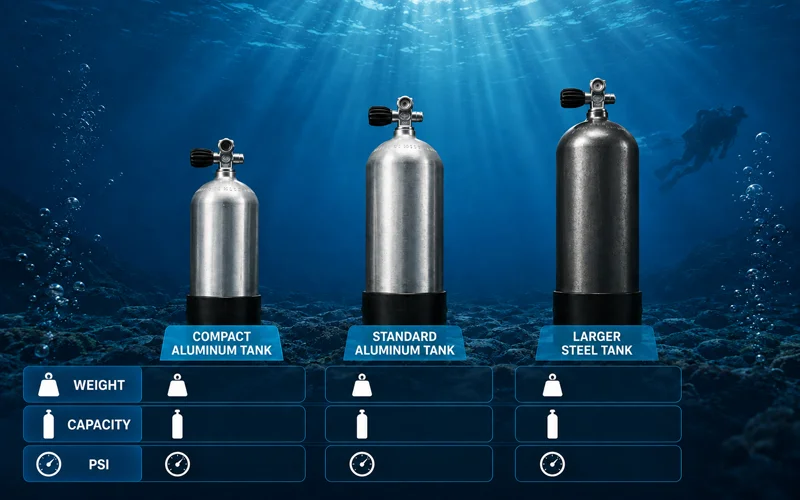
Weight and capacity are the two questions divers ask most before buying a tank, so here’s how the tanks on this list compare side by side. Figures are as published by each manufacturer’s listing.
| Tank | Material | Water Capacity | Weight | PSI |
|---|---|---|---|---|
| Faber FX Series 100 CF | — | 14 cubic feet | 34.3 lbs | 3442 |
| Faber 149 CF Steel | Steel | 101.4 cubic feet | 46.9 lbs | 3442 |
| Faber Stealth HP117 Steel | Steel | 100.1 cubic feet | 37.6 lbs | 3442 |
| Faber 80CF Blue Steel | Steel | 15 cubic feet | 28.6 lbs | 3442 |
| Sherwood 100CF Aluminum | Aluminum | 101.2 cubic feet | 46.2 lbs | 3300 |
| Faber 85CF | Aluminum | 103.5 cubic feet | 46.2 lbs | 3442 |
| Luxfer 80CF | — | 77.4 cubic feet | 31.5 lbs | Not listed |
| Faber High Pressure | — | 622 cubic feet | 28.6 lbs | Not listed |
| Catalina 80CF | Aluminum | 625 cubic feet | 34.7 lbs | Not listed |
As a rule of thumb, most recreational scuba tanks on this list weigh between about 28 and 47 pounds. Steel tanks tend to hold their weight underwater for smoother buoyancy control, while aluminum tanks are lighter to carry on land but get more buoyant as the air supply runs low.
Scuba tank sizes: what do 80CF, 100CF, and PSI numbers mean?
Tank names like “80CF” or “100CF” refer to how many cubic feet of air the tank holds when it’s filled to its rated pressure, not the tank’s physical dimensions. A 100CF tank carries more air than an 80CF tank, which generally means a longer dive before you need to surface, but it also means a larger, heavier cylinder to carry and store. That’s why capacity and weight are always a trade-off, and why it’s worth checking both numbers side by side in the comparison table above rather than looking at either one on its own.
The PSI rating works alongside the cubic-foot number, not instead of it. Two tanks can both be labeled “80CF,” but if one is rated to 3442 PSI and the other to 3000 PSI, they’re filled to different pressures to reach that same air volume, which affects tank wall thickness, weight, and which dive shops can fill them.
When you’re comparing tanks, look at cubic feet for how long you can stay down and PSI for how the tank is built and filled, and use a pressure gauge on your first dive with a new tank to see how the numbers translate into real bottom time for your breathing rate.
How much does a scuba tank weigh? Weight and buoyancy explained
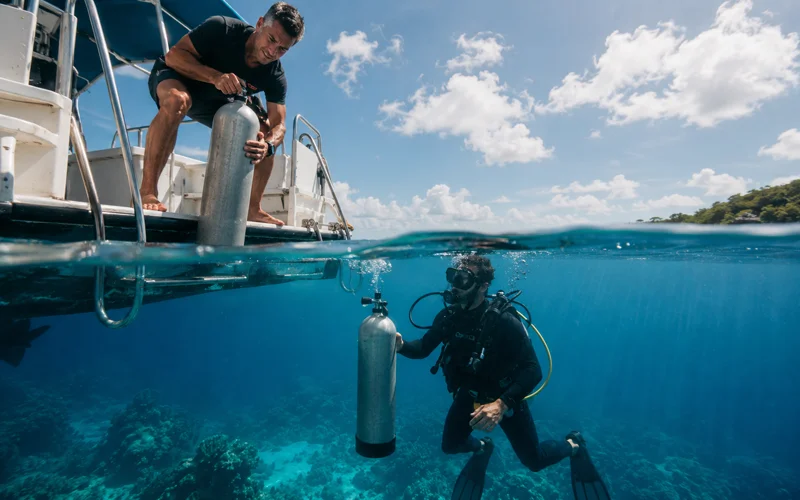
Based on the tanks in this guide, most recreational scuba tanks weigh between about 28 and 47 pounds empty. Where a given tank falls in that range comes down mostly to material and capacity: smaller aluminum tanks sit at the lighter end, while larger steel cylinders with more air capacity sit at the heavier end.
Weight and buoyancy are related but not the same thing. Steel tanks are heavier to carry on land, but they hold their negative buoyancy fairly consistently as you use up your air, which is why many divers find steel easier to manage underwater. Aluminum tanks are lighter to lift onto a boat or into a car, but they become more buoyant as the air supply runs low, so you may need to adjust your weighting partway through a dive to compensate.
Neither material is “better” across the board. It’s a trade-off between how the tank feels on land and how it behaves in the water, and it’s worth factoring in alongside the durability and corrosion resistance noted in the individual reviews below. As a general guideline, any tank over about 35 pounds is heavy enough that it’s worth storing on a heavy-duty hanger rather than a standard one between dives.
Scuba tank valve types, inspection, and maintenance
Scuba tanks use one of two valve types: Yoke (also called A-clamp) or DIN. A Yoke valve clamps your regulator’s first stage over the outside of the valve, while a DIN valve threads the regulator directly into the tank, which allows for a more secure, higher-pressure connection.
Several tanks in this guide, including the Faber Stealth HP117 Steel and the Catalina 80CF, are convertible between the two, so check which valve type your regulator uses before you buy, and confirm the tank you’re considering matches or can be converted to fit it.
A tank is only as good as its upkeep. Every scuba tank needs a visual inspection at least once a year, often called a VIP, or Visual Inspection Procedure, to check the interior and exterior for corrosion, dents, or damage. On top of that, tanks require a hydrostatic test, typically every five years in the U.S., to confirm the cylinder can still safely hold pressure.
Keep both certification stamps current, since most dive shops won’t fill a tank without them, and remember that not every shop can fill high-pressure tanks to their full rated PSI, so it’s worth calling ahead if you’re traveling with one.
Best scuba diving tanks reviewed
Some of the best tanks for scuba diving include the following:
Faber FX Series 100 CF
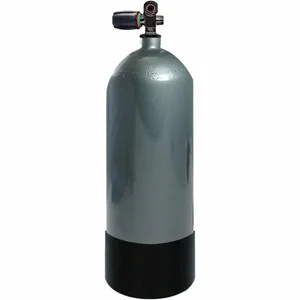
Water capacity: 14 cubic feet
Weight: 34.3 pounds
PSI: 3442
Scuba diving tanks can be low- or high-pressure, and this one is considered a high-pressure tank. Not only is it compatible with any type of drysuit, but it is perfect for both beginning and more experienced divers. In fact, this tank is perfect for both recreational and professional use, making it a very versatile item. And when you purchase it, you get a VIP, or free visual inspection of the tank, to give you confidence in using it.
Faber 149 CF Steel
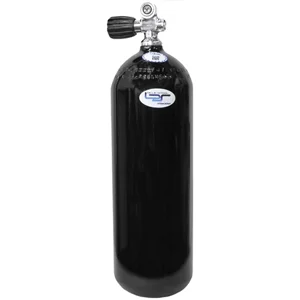
Water capacity: 101.4 cubic feet
Weight: 46.9 pounds
PSI: 3442
This is a high-pressure steel cylinder that allows you to enjoy more air than other tanks without having to buy a cumbersome or large tank. Yet another advantage is that the tank allows divers with all body types to use it comfortably, which cannot be said of all tanks out there. This is one of those tanks for which you’ll want a heavy-duty hanger built for scuba gear to store it when it isn’t being used.
Faber Stealth HP117 Steel
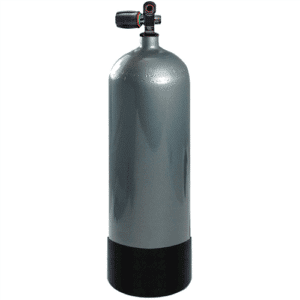
Water capacity: 100.1 cubic feet
Weight: 37.6 pounds
PSI: 3442
This is yet another tank that you’ll need special storage equipment for, thanks to its heavy weight. Steel scuba tanks tend to be lighter than aluminum scuba tanks; however, aluminum itself is lighter than steel. But manufacturers always add additional aluminum to make the tank stronger, making them heavier than steel tanks. This tank will stand up on a flat surface because of its boot shape, and it has a yoke that can be easily inserted and converted.
Faber 80CF Blue Steel

Water capacity: 15 cubic feet
Weight: 28.6 pounds
PSI: 3442
Faber has more than 40 years of experience making high-quality scuba diving tanks, so they are true experts in the field. This one is slightly heavy but has just the right amount of pressure. The tank has been highly rated by real-life customers and has even been treated with a rust inhibitor. Thanks to its chrome plates, it is also very durable and long-lasting. It is protected by zinc and epoxy and even has a polyurethane finish for extra sturdiness.
Faber Stealth HP117 Steel
Water capacity: 100.1 cubic feet
Weight: 37.6 pounds
PSI: 3442
This is yet another tank that you’ll need special storage equipment for, thanks to its heavy weight. Steel scuba tanks tend to be lighter than aluminum scuba tanks; however, aluminum itself is lighter than steel. But manufacturers always add additional aluminum to make the tank stronger, making them heavier than steel tanks. This tank will stand up on a flat surface because of its boot shape, and it has a yoke that can be easily inserted and converted.
Faber 80CF Blue Steel
Water capacity: 15 cubic feet
Weight: 28.6 pounds
PSI: 3442
Faber has more than 40 years of experience making high-quality scuba diving tanks, so they are true experts in the field. This one is slightly heavy but has just the right amount of pressure. The tank has been highly rated by real-life customers and has even been treated with a rust inhibitor. Thanks to its chrome plates, it is also very durable and long-lasting. It is protected by zinc and epoxy and even has a polyurethane finish for extra sturdiness.
Sherwood 100CF Aluminum
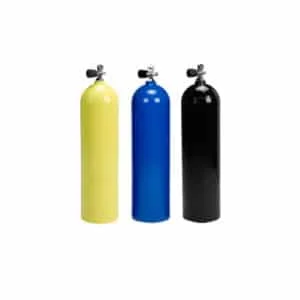
Water capacity: 101.2 cubic feet
Weight: 46.2 pounds
PSI: 3300
Yet another tank that needs a Tough Hook hanger built for scuba divers, this one is available in black, blue, and yellow. More importantly, it is slightly neutral in buoyancy. In practical terms, this feature makes it perfect for beginning divers, although any diver can use this tank with ease. Because it utilizes thermoplastic polyurethane in the BC air cell, it is also a very durable, long-lasting tank.
Faber 85CF
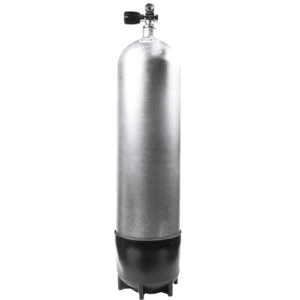
Water capacity: 103.5 cubic feet
Weight: 46.2 pounds
PSI: 3442
When you’re looking for the best scuba diving tanks, researching Faber tanks is always smart. As with other tanks on this list, this one needs a Tough Hook XL hanger. It is specially made to be both shock- and corrosion-resistant. The high-strength aluminum and alloy liner comes with an excellent glass fiber, and it can be cleaned easily with oxygen. It also has a rather industrial look, but this is due to the hot-dipped galvanized cylinder.
Faber 85CF
Water capacity: 103.5 cubic feet
Weight: 46.2 pounds
PSI: 3442
When you’re looking for the best scuba diving tanks, researching Faber tanks is always smart. As with other tanks on this list, this one needs a Tough Hook heavy-duty hanger. It is specially made to be both shock- and corrosion-resistant. The high-strength aluminum and alloy liner comes with an excellent glass fiber, and it can be cleaned easily with oxygen. It also has a rather industrial look, but this is due to the hot-dipped galvanized cylinder.
Luxfer 80CF
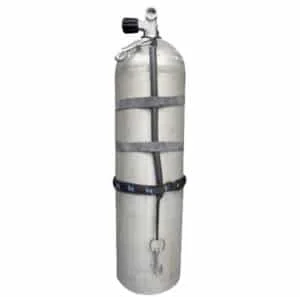
Water capacity: 77.4 cubic feet
Weight: 31.5 pounds
Because of its Pro Valve capability, this tank has one of the highest scuba cylinder valves on the market today. In fact, this is such an efficient tank that it is often used in scuba-diving classes and on boats. It also comes in a variety of colors, including red, blue, green, and purple, and therefore makes divers feel more fashionable as they participate in this exciting sport.
Faber High Pressure
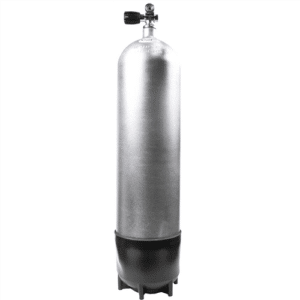
Water capacity: 622 cubic feet
Weight: 28.6 pounds
Although small and lightweight, this tank offers divers a lot of bang for their buck. It also has great buoyancy characteristics that make it perfect for more advanced or even professional divers. The durable finish means that you’ll be able to enjoy it for a very long time, and its optimal volume makes it super-easy for you to carry even on the surface. It even has air reserves in case you need them, and it has gotten tons of top-notch reviews as one of the best scuba diving tanks in the market from customers.
Catalina 80CF
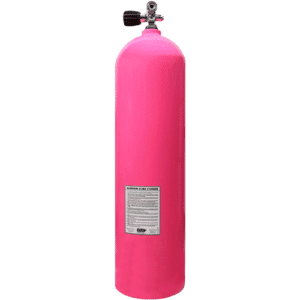
Water capacity: 625 cubic feet
Weight: 34.7 pounds
This is a corrosion-resistant aluminum cylinder that is perfect for people who are looking for a more compact tank. The aesthetics of the tank do not react with salt water, and it is a convertible type that can work in Yoke or DIN. Although cost-efficient, it still has the characteristics that most divers are looking for, and its good underwater weight makes it the perfect tank for people who expect deeper navigation than normal.
Store your scuba tank and gear the right way
A full steel or aluminum tank is heavy, wet, and awkward to store on a standard closet hanger. Once you’re back from a dive, rinse your gear and give it a spot to dry out properly. Tough Hook’s heavy-duty hangers are built to carry the weight of wet dive gear without bending or snapping, and they hold up in the saltwater and humidity that break down regular hangers over time. Take a look at the full Tough Hook hanger lineup to find the right setup for your gear closet or garage.
FAQs
What is the difference between steel and aluminum scuba tanks?
In the world of scuba tanks, your two main choices are steel or aluminum. Aluminum tanks, while easier on your back when lugging them around on land, tend to become buoyant when the air supply runs low, which could affect your control underwater. Steel tanks are a bit heftier, but they hold their weight underwater, making buoyancy management smoother throughout your dive.
What are some factors to consider when buying scuba diving tanks?
Investing in a scuba tank requires careful thought. You’ll want to weigh the pros and cons of steel versus aluminum. Also look at the size and capacity to make sure it’s enough for your diving style, and consider how that affects the tank’s weight. Check the valve type to ensure it’s compatible with your gear, and always look for valid inspection and certification stamps. Safety always comes first.
What does water capacity in scuba tanks mean?
It’s not about taking a sip during your dive. The “water capacity” actually refers to the volume of water that could fill the tank, measured in liters. It helps determine the amount of gas the tank can hold, giving you an idea of the air supply you’ll have for your dive.
What does the PSI number in a scuba tank indicate?
The PSI, or pounds per square inch, is a pressure rating. It tells you the maximum pressure of air that the tank can safely contain. It’s important for calculating your air supply, and you’ll typically see numbers like 2400 or 3000 PSI. Always follow the manufacturer’s guidelines when filling the tank.
What is the difference between low-pressure and high-pressure scuba tanks?
The primary difference is the amount of air pressure they can safely hold. Low-pressure tanks usually have a PSI rating of around 2400 to 2650 and are often a bit heavier. High-pressure tanks can handle up to 3442 PSI and tend to be lighter, making them easier to handle. It’s worth noting that not all dive shops can fill high-pressure tanks to full capacity.
How much does a scuba tank weigh?
Based on the tanks in this guide, most recreational scuba tanks weigh between about 28 and 47 pounds. Smaller aluminum tanks tend to sit at the lighter end of that range, while larger steel cylinders sit at the heavier end. Tanks over 35 pounds are worth storing on a heavy-duty hanger rather than a standard one.
What are some of the best scuba diving tanks on the market?
Some popular tanks among divers include the Faber FX Series 100 cu ft High Pressure for its capacity and buoyancy characteristics, and the Catalina 80 cu ft Aluminum for its blend of capacity and weight. The Luxfer 80 cu ft is also well-regarded for its durability and compact size. The best tank for you will depend on your specific diving needs and preferences.
Let us know what do you think of this Scuba Tank list of if we should add one to this list and why in the comment section below!